- What is an MT5 cent account?
- Which brokers offer a cent account?
- Brokers offering cent accounts in Malaysia
- Key features of the best cent account brokers
- Are cent accounts right for a beginner?
- How a cent account compares to micro, standard, and demo accounts
- Minimum deposit to open a cent account
- Testing the account with EAs and small positions
- Versus Trade cent and standard accounts
- Final broker checklist
A small deposit on a reliable CFD trading platform can generate a surprisingly long trading history. One position tests the spread, another shows how margin gets calculated, and an overnight trade introduces the first swap entry. That is where a cent account earns its place: it carries a strategy from simulation into real money without forcing standard-sized monetary exposure.
Financial risks remain at any account size. The forex market is decentralised, and forex and CFD quotes travel to the account through the broker’s system. Orders encounter live market conditions, and high leverage can drain a modest balance fast. How to choose a sent account broker, therefore, involves lot sizes, costs, platform access, and the legal entity, rather than the lowest minimum deposit alone.
Versus Trade Cent uses USC as its base currency, starting at $10, and runs on MT5. The comparison that matters begins after those headline numbers, with contract size, execution, swaps, and the markets actually available.
What is an MT5 cent account?
A cent account is a type of live trading account that denominates its balance in cents rather than dollars. Deposit $10, and the terminal shows ¢1,000. If the balance drops by ¢100, the monetary loss is $1. The larger number does not create extra capital or real profit.
The cent denomination says nothing about contract size. One broker may tie 0.01 lot to a different monetary value than another. Contract size, tick value, minimum volume, volume step, and any required currency conversion all shape how much one pip moves the position. These specifications carry more weight than an awkward search phrase such as “account cent MT5,” which lumps together the account currency, platform, and trade size without separating them.
A demo account sits on the other side of that line. It runs on simulated funds and works well for trying out trading before putting capital at risk. A Cent account adds real trading, variable spreads, order fills, and the psychological weight of trading with real money. That puts it between a demo account and a full standard account, with real money and real risks attached.
Explore the Versus Trade platform and discover the tools traders use to analyze markets, manage risk, and improve performance.

How cent denomination changes the experience
Smaller monetary increments give a beginner room to observe errors that would cost more elsewhere. New traders can test strategies, calculate a pip value, and practise order management while losses are calculated in cents. Experienced traders may also turn to cent accounts to test new strategies or Expert Advisors before committing more money.
The account faces live, account-specific trading conditions. Spreads may widen, a stop can fill away from its trigger during gaps or fast markets, and several correlated positions can build more exposure than their individual sizes suggest. The cent account provides an opportunity to practice under live market conditions, while position sizing, stop placement, and overall risk management keep exposure in check.
Which brokers offer a cent account?
Cent account offers appear at Versus Trade, RoboForex, and JustMarkets. RoboForex publishes ProCent, while JustMarkets has promoted Standard Cent. RoboMarkets is a separate brand, so reading ProCent across to RoboMarkets would be a mistake. An international product page also does not signal availability in every country.
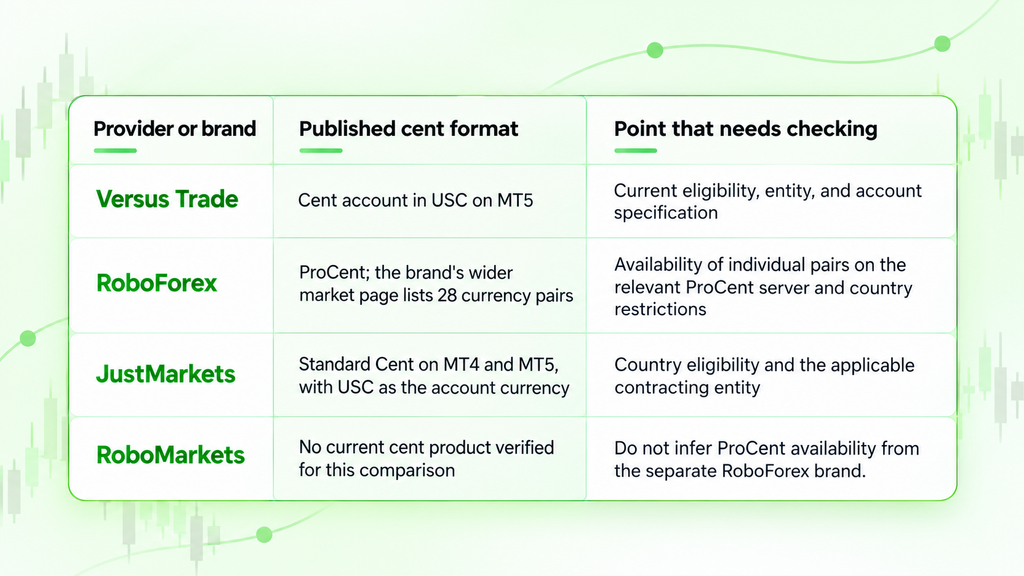
Lists of the best cent account forex brokers may describe these firms as top brokers, though rankings weigh spreads, leverage, education, and instruments in different ways. Product availability and legal documents provide a firmer shortlist.
The same discipline applies across forex trading. A cent account forex broker sets the contract, the execution model, and the available symbols. The platform developer supplies software without becoming the counterparty to the trade.
Brokers offering cent accounts in Malaysia
Versus Trade serves clients globally, including in Asia, Africa, and Latin America, except in restricted jurisdictions such as the US, Canada, Iran, Myanmar, North Korea, the EU/EEA, the UK, Russia, and Belarus. Malaysia is absent from that exclusion list. Availability and the contracting company still require confirmation during registration. RoboForex states that its advertising does not target Malaysian residents, so ProCent is not promoted to Malaysian clients.
RoboForex Ltd says it is regulated by the FSC of Belize. CySEC stands for the Cyprus Securities and Exchange Commission. Neither of those equals authorisation by the Securities Commission Malaysia. Versus Trade plainly holds no specific Malaysian licence and advises Malaysian clients to understand local rules before trading with an international broker. The SC Investment Checker and registers provide the local reference point.
Global Director of Online Broker Research at ForexBrokers.com—Steven Hatzakis, Best Forex Brokers for 2026, September 11, 2026
For Malaysian traders, due diligence covers the legal name, licence, domain, client agreement and complaints route. It also confirms account and payment-method availability before funds are sent.
Keep your strategy running beyond the trading day with swap-free conditions, including dedicated Islamic account options.

Key features of the best cent account brokers
The right account rarely gets identified by a single number. Trading conditions work together as a package: contract size sculpts pip value, spreads set entry cost, leverage drives margin, and swaps affect overnight positions. A broker with cent account access should disclose each element before asking the client to open a cent account.
Contract size, instruments, and execution
The symbol specification lists contract size, tick value, minimum volume, maximum volume, and volume step. Micro lots vary from one broker to the next, even when both platforms accept 0.01 lot. EAs also need the correct symbol names and server settings. An algorithm built for a standard account may place unsuitable trades if it assumes a different contract and opens positions at the wrong size.
Instrument coverage needs a direct check. Versus Trade Cent focuses on forex and metals, while some competing accounts describe their range as pairs and metals or list a fixed number of currencies. A broader standard account may add indices, cryptocurrencies, energies, stocks, or ETFs. More instruments only help when they match the trading strategies in play.
Execution shows up in the account history. Filled prices, rejected orders, and slippage reveal how the setup behaves outside ideal conditions. A short trading experience cannot prove long-term quality, but it can show whether the live server performs as the specification describes.
Costs, leverage, and swap-free trading before a deposit
Cost claims need like-for-like comparisons. JustMarkets lists Standard Cent spreads from 0.3 pips. A figure such as “1.2 pips” needs an instrument, account, pricing basis, and observation period attached. Low spreads and tight spreads require the same context. A commission-free account can still carry other costs.
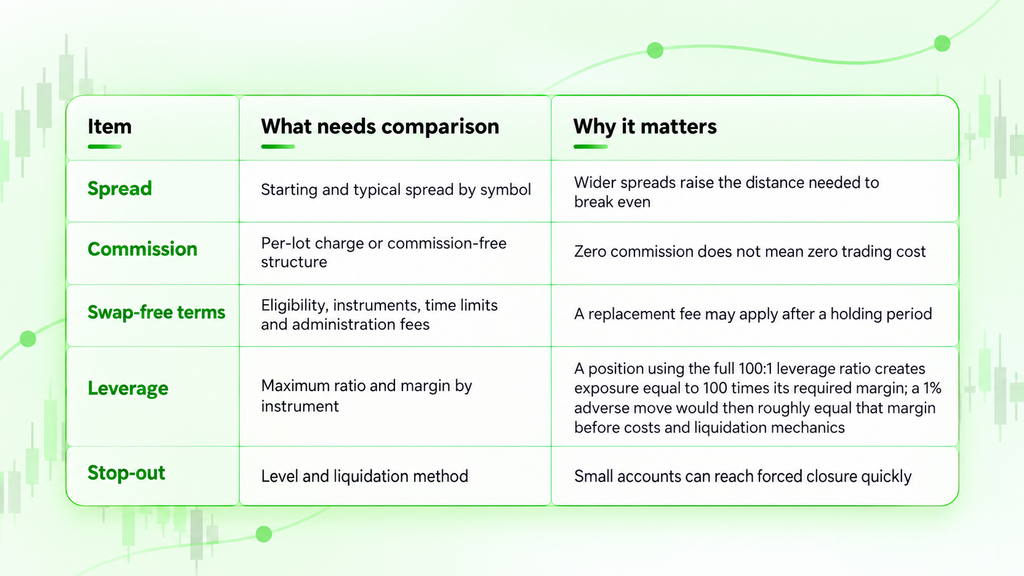
Swap-free eligibility may depend on the client, instrument, and holding period. Some arrangements remove the conventional swap but later apply an administration fee. Written terms expose that difference.
An older JustMarkets educational page refers to a $1 minimum deposit, but its current Standard Cent table states $10, which takes precedence. A €10 minimum deposit also needs a named account, entity, and current product page before it becomes a broker fact. Versus Trade sets a $10 minimum for Cent.
A Forex Affiliate program is a separate partner arrangement, separate from Cent features. Amirul Mazlan makes that distinction in “Most IBs Are Building Someone Else’s Business”: an IB develops its own community and reputation instead of leaning on one promotion. Referral work needs a separate agreement and compliance checks.
Are cent accounts right for a beginner?
A cent account suits a beginner who understands basic order types and accepts that losses are possible when trading with real money. A smaller position in cent denomination carries less financial risk in dollar terms than the same instrument at a larger size, but the cent label does not reduce market risk. Poor position sizing can still drain the account.
A beginner gains most when the account has one clear purpose: learning execution, testing a single strategy, or verifying EA volume. Comprehensive educational material supports this process but never replaces risk limits.
Traders with limited capital need to separate affordability from suitability. Being able to start forex trading does not mean every strategy fits the balance. Wide stops or several positions at once may require more room than the account provides.
Advantages and cons of cent accounts
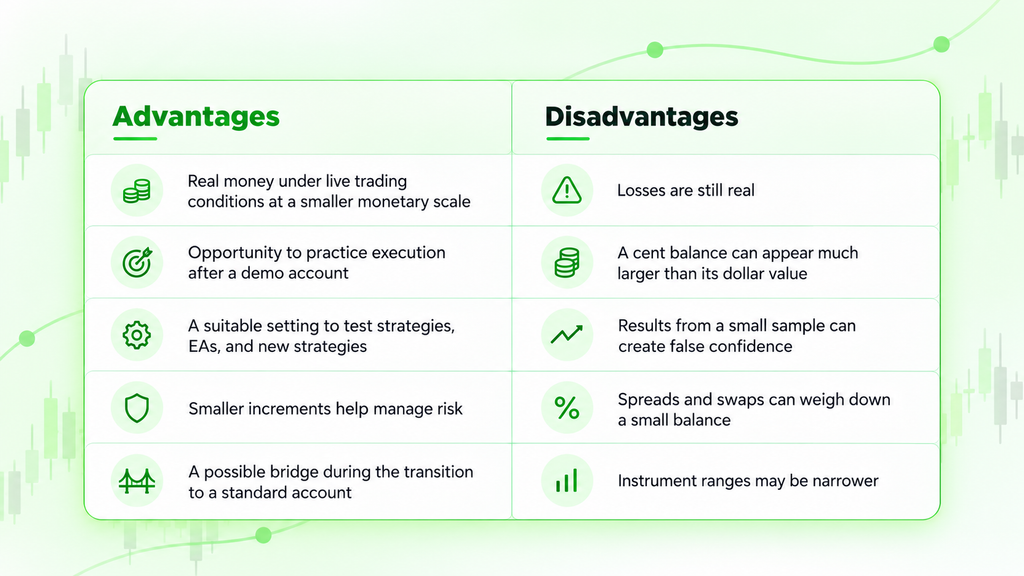
The main cons of cent accounts relate to trader behaviour and product limits. Cents rather than dollars can obscure the true economic value of a position, so every risk limit still needs conversion into ordinary currency.
Co-Founder of Versus Trade—Vitalii Bulynin, Desire To Trade, June 28, 2026
Investor protection begins with the entity and the agreement you sign. Negative balance protection applies only where the terms provide it, and it does not prevent loss of the balance.
How a cent account compares to micro, standard, and demo accounts
These four labels describe different features. Learning how to use MetaTrader 5 reveals the differences in the symbol specification and account details. “Cent” refers to monetary denomination. “Micro” normally refers to smaller contract or lot sizes. Standard accounts use ordinary currency units and often provide a wider instrument range. A demo account describes simulated funds rather than a live account.
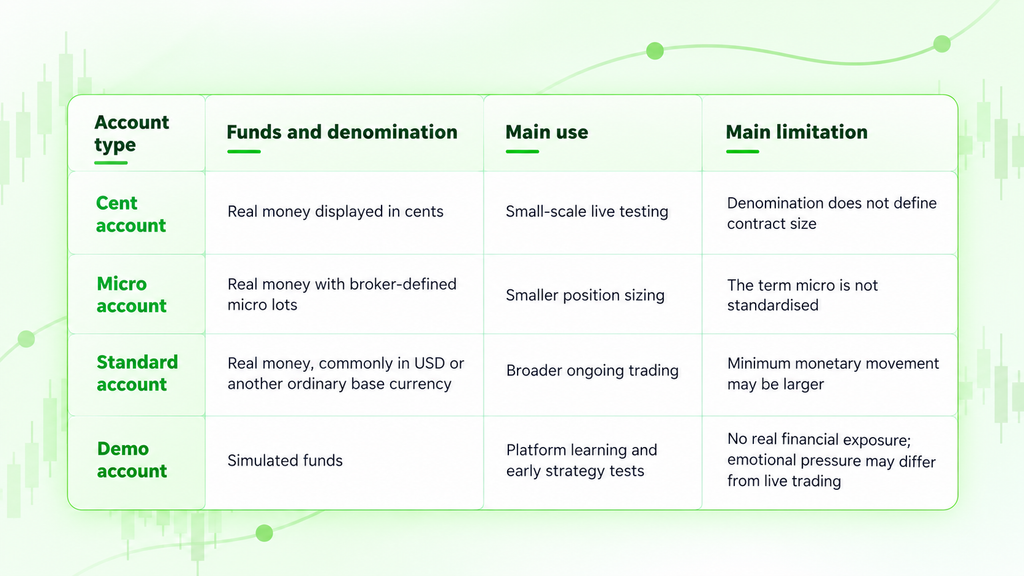
A cent account gives a closer view of live execution than a demo account, while a micro account may or may not use the cent denomination. A standard account often covers broader instruments or larger capacity. None of these labels establishes low risk.
Minimum deposit to open a cent account
Minimum deposit requirements vary by broker, entity, funding method, and account type. A published threshold such as $1 or €10 is not a recommended trading budget. Use it only when the current product specification supports it. Versus Trade currently requires $10 to open a cent account.
The practical deposit depends on the minimum position, stop distance, and how many trades run at once. One currency position may fit where several correlated trades do not. Conversion matters when your funding currency differs from USC or USD.
Platform familiarity belongs in the deposit decision because you need to verify contract specifications, margin figures, and account currency before you start trading.
Testing the account with EAs and small positions
The account should be tested in stages. A beginner can locate the symbol specification, margin figures, order history, and account currency before placing any trade. The next step uses the minimum live position instead of jumping straight from simulation to the intended long-term size.
- Confirm the legal entity and country eligibility.
- Check the Cent server, base currency, and contract specification.
- Calculate pip value, margin, and maximum loss at the stop.
- Place the minimum volume under ordinary market conditions.
- Record spreads, fills, swaps, and any rejected orders.
- Test expert advisors with the correct symbol names and lot rules.
- Request a small withdrawal before depositing more.
Platform choice changes that workflow. MetaTrader 4 or MetaTrader 5 comparison matters because an MT4 cent account may use the same cent denomination, while its indicators and EAs should not be assumed to work on MT5. A WebTrader may also omit or handle tools differently from the desktop terminal.
This test separates software familiarity from the broker-specific conditions governing order handling, margin, and account costs.
Versus Trade cent and standard accounts
Versus Trade Cent uses USC, covers forex and metals, and lists spreads from 1.4 pips. The Standard account uses USD or MYR, covers a broader instrument range, and lists spreads from 0.4 pips. Both currently show a $10 minimum deposit, zero commission, leverage up to 1:2000, and a nominal platform volume range of 0.01 to 200 lots. Actual monetary exposure depends on the contract size shown in each symbol’s specification.
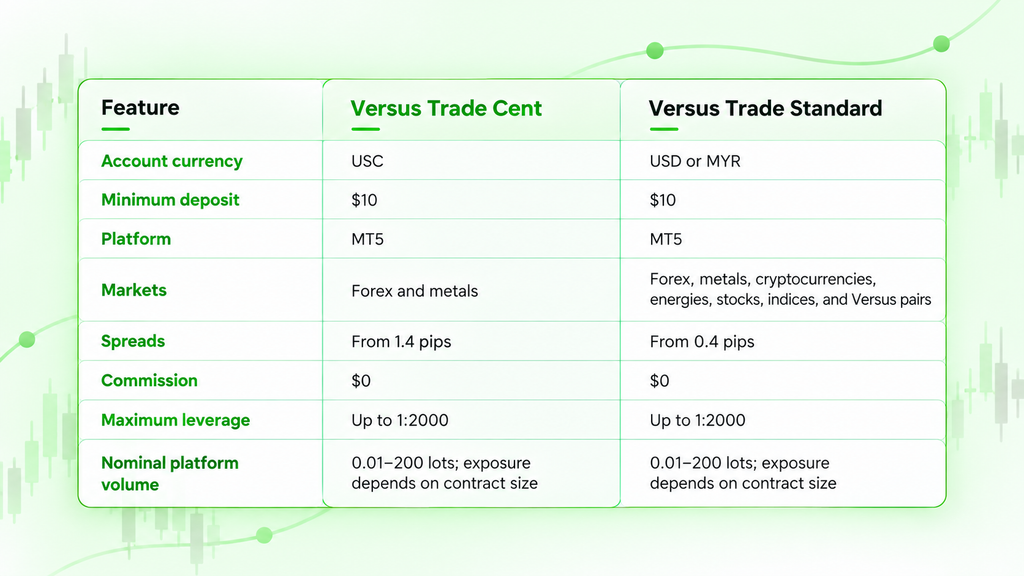
Cent is useful when smaller monetary increments matter. Standard becomes relevant when instruments or pricing outweigh that benefit.
Funding is the final operational check. Versus Trade explains how to transfer funds to MT5, while the current Personal Area and client agreement remain the controlling documents if a method or procedure changes.
Final broker checklist
- The exact entity, licence, and domain match official records.
- The account and contracting entity are available to Malaysian applicants.
- Cent denomination, contract size, and micro lots are not confused.
- Typical spreads, commission, and overnight costs have been compared.
- Swap-free eligibility and administration fees are documented.
- Leverage fits the position size rather than a profit target.
- Forex, metals, and any required instruments are available.
- The platform supports the intended indicators and EAs.
- Deposit and withdrawal procedures have been tested.
- Money needed for living costs or savings remains outside the trading account.
The right cent account forex broker combines verifiable regulation, workable costs, suitable platform access, and a contract aligned with your risk limit.
- What is an MT5 cent account?
- Which brokers offer a cent account?
- Brokers offering cent accounts in Malaysia
- Key features of the best cent account brokers
- Are cent accounts right for a beginner?
- How a cent account compares to micro, standard, and demo accounts
- Minimum deposit to open a cent account
- Testing the account with EAs and small positions
- Versus Trade cent and standard accounts
- Final broker checklist