A new trader can see a first virtual gain arrive within minutes. Price moves upward, the position closes in green, and the next order gets a larger size. Then a few clicks later the gain evaporates. No actual money left the account, but the sequence reveals habits that would hurt once real money is on the line.
That is exactly where a trading demo account earns its place. It changes online trading from a vague concept into a routine you can watch, repeat, and review. Virtual funds sit in the account while live prices, charts, order forms, and analysis tools create the training space.
Early sessions can focus on a short set of tasks:
- get comfortable with the platform and app without rushing
- open, change, and close an order
- place stop-loss and take-profit levels
- check spread, margin, and leverage before entering
- write down why a position was opened and how it ended
Because no immediate financial loss is on the table, you can experiment. The market stays unpredictable, and the results won’t automatically transfer to live trading.
What is a trading demo account?
A demo account is a simulated trading account loaded with virtual capital. The platform and market data come without needing fresh money for every trade. Assets can include currency pairs, indices, commodities, shares, metals, and futures or contracts tied to them.
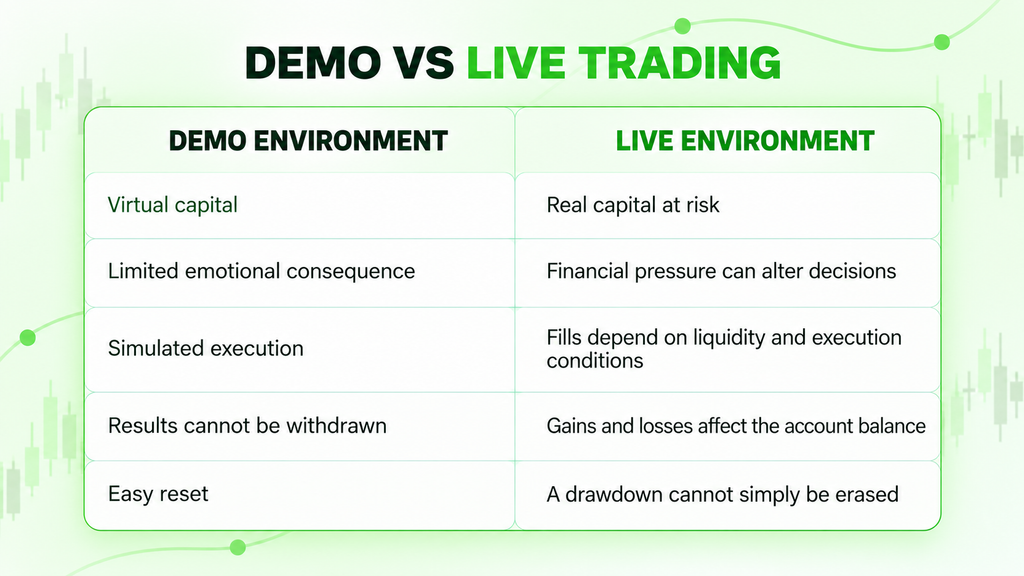
Prices can track the live market, yet the account stays a simulation. Profits usually can’t be withdrawn, and losses don’t touch your financial situation. What matters sits between those outcomes: the order you picked, the size you used, the exit rule, and whether the plan survived volatility.
What a demo account can teach
Repeated sessions make market and pending orders easier to tell apart. Watching margin change shows what leverage does. Charts reveal how an indicator acts in trends and ranges.
You can use a demo account to test strategies and try different approaches without risking real capital. One setup may follow a moving average; another may wait for a set price level. Side-by-side records say more than a single profitable trade.
Group President and US CEO at Webull—Anthony Denier, LinkedIn, 3 August 2026
A virtual position cannot lose real money, but careless practice still builds bad habits. Oversized positions, rules that keep changing, and impulsive re-entries create a false sense of progress.
You can open a free demo account at Versus Trade and run the same test yourself.
Try strategies, explore MT5 and get a feel for the markets with a demo account before putting real capital on the line.

How to use a demo trading account as a real test
Random clicks only teach button locations. A structured test shows whether a method can be executed consistently. Traders who practice trading with a fixed routine can separate platform mistakes from holes in a strategy.
Match the virtual balance to a realistic starting amount
A $100,000 balance can encourage position sizes that have little connection to the amount eventually available for a live account. A realistic balance makes margin use, drawdown, and position sizing count. If your planned deposit is small, the virtual account should not make every loss look trivial.
Define the test before opening positions
Basic rules should name the asset, session, entry condition, exit condition, maximum loss per trade, and daily loss limit. Testing currency trading during the Asian session is a different experiment from holding an index position through US economic data.
Keep variables stable
Swapping the indicator, timeframe, and risk level after every loss makes results hard to evaluate. A useful sample keeps the same rules across enough trades and different market conditions. You want to see where the approach breaks, not to produce a pretty profit curve.
Keep a decision journal
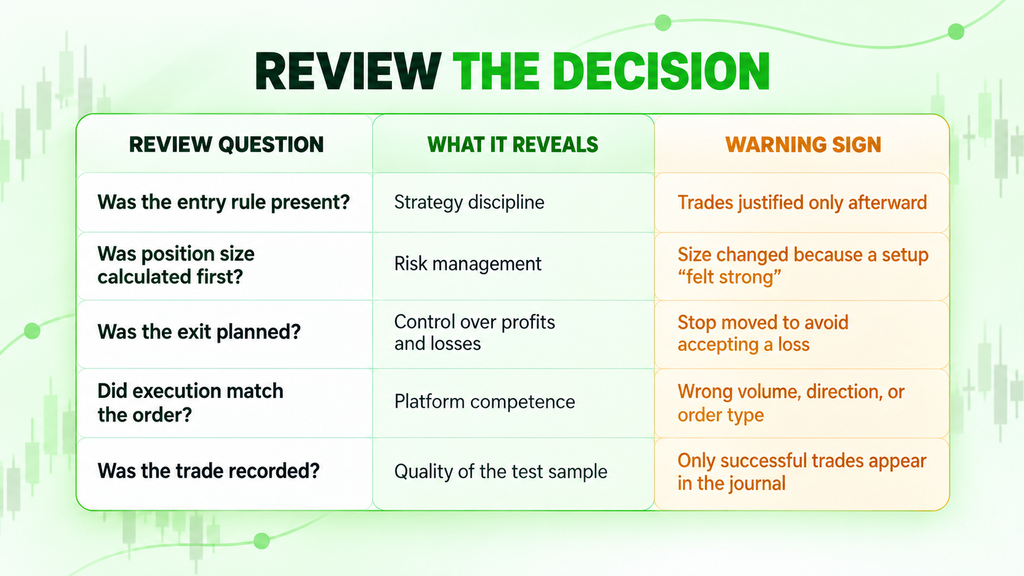
Every entry can log setup, order type, planned risk, result, and any deviation from the rules. Screenshots show whether the trade matched the idea you wrote down. Recurring mistakes surface over time: late entries, moving a stop, sizing up after a loss, or dropping a valid setup in volatility.
A journal also limits hindsight. The reason written before entry gets compared with the story told after exit. When those accounts keep disagreeing, the method is being bent around outcomes instead of tested. That matters most after a winning trade, when a mistake is easy to excuse because it produced a gain.
That difference moves record-keeping from paperwork into the experiment itself. The workplace piece From Day One to Everyday: What Makes People Systems Actually Work? studies a different setting, but the title captures the test. A trading routine counts when it turns into an everyday process, not when it sits as a day-one document.
Review process and outcome separately
A good decision can lose and a poor one can profit. Review both. Useful numbers include rule adherence, average gain and loss, maximum drawdown, consecutive losses, and performance under different volatility. The figures cannot promise future returns, but they challenge loose confidence.
Forex demo account and CFD demo account: what changes?
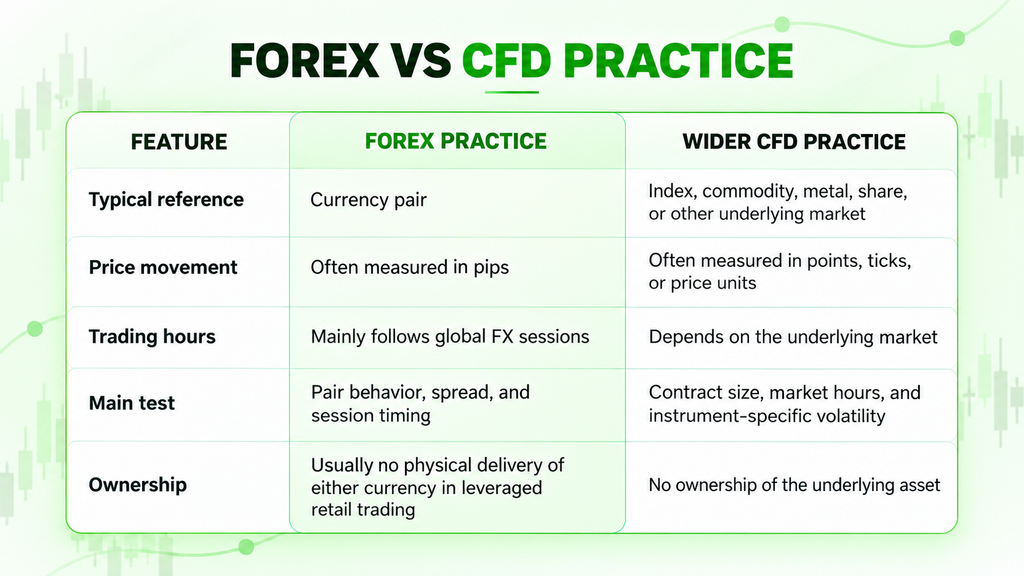
A forex demo account focuses on pairs like EUR/USD or USD/JPY. You see bid and ask prices, pip moves, margin requirements, and how economic releases hit the market. That same space works for forex trading strategies that need precise stops.
A CFD demo account can cover wider underlying markets. You speculate on price moves without owning the underlying asset. Contract size, trading hours, financing treatment, and volatility differ across index, metal, energy, and share CFDs.
Moving between these markets takes more than a profitable virtual balance. Instrument specifications decide how much a one-point move changes the account, how much margin a position uses, and when you can trade it. A trader preparing to trade forex CFD needs these details in every test, because equal position sizes can carry very different exposure.
Demo trading account versus a cent account
A demo trading account uses virtual funds. A cent account is live, shows its balance in cents, and can allow small trade sizes. Real capital stays at risk even when each position has a low dollar value.
The cent format adds real consequences without forcing standard-account position sizes. It can work as a later bridge, but it is not risk-free.
Why demo trading does not feel like live trading
The clearest gap is emotional pressure. A virtual loss doesn’t touch savings or next month’s budget. Fear, greed, hesitation, and the urge to win back a loss may grow stronger with real money. Rules followed calmly in simulation can bend once the result carries financial weight.
CEO and Co-Founder of Versus Trade—Vitalii Bulynin.
Source: The Future of Forex Markets, FXStreet, 15 July 2026.
Execution can differ as well. Trading demo platforms may not reproduce every fill delay, rejection, liquidity limit, or bit of slippage. Around a volatile release, a live spread can widen and a market order may execute away from the displayed price.
How to choose the best demo account for the job
The best option is rarely the one with the biggest virtual balance. A useful account looks like the live environment you intend to trade.
Market access and platform tools
Instruments should match your target markets. Charts, indicators, order types, account history, and mobile access need to support the routine. An easy trading platform lowers operational mistakes but doesn’t replace clear contract specifications.
A broker site may place account types, education, and a Forex affiliate program inside the same ecosystem. These pages have different jobs. A trader checking free demo accounts looks at market access, execution settings, tools, and the path to a real account. An affiliate weighs a commercial relationship.
Realistic conditions and transparent limits
The spread, leverage, market data, and expiry policies vary. Demo accounts may stay active with regular use or close after a set period, which changes how long a test can run.
For Indonesian users, checking the provider stays part of the process. Bappebti keeps a public legality-checking portal for participants in Indonesia’s commodity futures sector. A polished demo does not establish a provider’s regulatory status or make a leveraged product suitable for every trader.
A practical selection checklist
- Confirm that the required markets and order types are available.
- Check whether prices and hours resemble the intended live account.
- Review the balance, leverage, spread, and expiry period.
- Test the desktop platform and mobile app.
- Read the entity details, risk disclosure, and account conditions.
Open a demo account at Versus Trade and walk through this checklist before you trade.
Explore the Versus Trade platform and discover the tools traders use to analyze markets, manage risk, and improve performance.

When is a trader ready to go live?
Virtual profit alone is a weak signal. Good conditions or oversized leverage can turn luck into a strong return. Repeatable behavior says more.
Readiness shows up as fewer order mistakes, positions you can explain, steady sizing, and losses accepted without rewriting the plan. Results should cover quiet and volatile market conditions. A drawdown cannot be erased.
Real trades show whether your execution assumptions were realistic and whether discipline survives financial pressure.
A simulator cannot certify a strategy or remove market risk. Its value is fewer mechanical errors, clearer evidence, and rules strong enough to show when they break.