- What are CFDs?
- What is options trading?
- The regulation that exists because of this exact debate
- The warnings vs. the advocacy
- What Indonesian traders are watching
- Common mistakes with CFDs and options
- How to approach CFDs and options responsibly
- Are CFDs and options worth trading? Weighing it honestly
- Conclusion: let the regulation set your starting point
Few products have as split a reputation online as CFDs. Search “trading cfd” and you’ll find a broker’s own explainer, a trading academy calling it a tool “smart investors” use, and a prop trading firm listing “3 reasons to stop,” all on the same page. The best starting point is the regulation that already exists specifically because of how divisive this product is.
What are CFDs?
A CFD (contract for difference) lets you bet on whether an asset’s price goes up or down without actually owning it. You put down an initial margin deposit, and leverage lets you control a bigger position than that deposit alone would cover. If the price moves your way, your profit is calculated on the full position size. If it moves against you, your loss is calculated on the full position size too.
“Demystifying CFDs: How Contracts for Difference Work” (UKspreadbetting, YouTube), “What are Contracts for Difference (CFDs)?” (ADSS, YouTube), and “What is CFD Trading?” (Plus500, YouTube) all cover these mechanics from different broker perspectives. In Bahasa, “Apa Itu CFD Market & OTC Market” (Orbi TV, YouTube) covers the identical ground, framed around over-the-counter market structure specifically.
What is options trading?
Options are a different instrument entirely. An option gives its buyer the right (but not the obligation) to buy or sell an asset at a set price on or before a set date, depending on the contract. The buyer pays a premium upfront for that right, and the most the buyer can lose on the option itself is that premium. Option sellers take on an obligation if assigned and may face much larger, sometimes theoretically unlimited, losses.
Fidelity’s “What is Options Trading and How Does it Work?” (Fidelity Investments, YouTube) and “How To Place An Options Trade” (Fidelity Investments, YouTube) are notable for the source: a large, regulated US brokerage teaching the mechanics directly, rather than a third-party creator monetizing an affiliate link. That doesn’t make the content unbiased (Fidelity sells options trading too), but it is a very different incentive structure from most of the rest of this cluster.
The regulation that exists because of this exact debate
The “stop trading CFDs” versus “smart investors trade CFDs” argument isn’t new to YouTube. Regulators had the same argument almost a decade ago, and it ended in hard rules.
In 2018, the European Securities and Markets Authority (ESMA) capped the leverage retail clients can use on CFDs by asset class: 30:1 for major currency pairs, 20:1 for non-major pairs, gold, and major indices, 10:1 for other commodities and non-major indices, 5:1 for individual equities, and 2:1 for cryptocurrencies. The measures also introduced negative balance protection on a per-account basis, limiting a retail client’s aggregate liability across all CFDs connected to a trading account to the funds in that account (ESMA product intervention measures on CFDs, effective 1 August 2018).
Now think about what that means. A financial regulator looked at the evidence, decided retail traders were getting hurt, and put hard caps on how much leverage they could use, broken down by asset class. ESMA did not ban CFDs, but it concluded that leverage limits and account-level protections were necessary. That tells you the evidence supported tighter guardrails rather than treating the product as harmless.
The warnings vs. the advocacy
“3 Reasons To STOP TRADING CFD’s” (Axia Futures, YouTube) and “CFD vs. Futures Trading: Understanding the Differences” (Ali Casey – StatOasis, YouTube) both frame CFDs as the weaker instrument next to exchange-traded futures, commonly citing counterparty structure and cost. On the other side, “Smart Investors Are Trading CFDs – Want To Understand Why” (Investors Trading Academy, YouTube) argues the accessibility and flexibility (fractional exposure, going short easily, wide market access from one account) outweigh the drawbacks for the right use case.
Both arguments are defensible. They’re just describing different investor profiles and different amounts of accepted risk.
What Indonesian traders are watching
“CFD Stock & Indeks Amerika Mana yang lebih Menarik?” (Maxco Futures Official, YouTube) compares US stock and index CFDs directly for a Bahasa-speaking audience, tied to NFP (US jobs data) release timing. It’s a good example of local content applying a global product to a specific, recurring market event rather than teaching it in the abstract.
Common mistakes with CFDs and options
The most common mistake is cranking leverage to the maximum just because it’s available. The regulatory caps above exist as a ceiling, not a target. Using less than the max is usually the safer starting point.
And “smart investors use this” doesn’t automatically mean “this is right for me.” CFDs and options both reward specific risk tolerance and specific monitoring habits. Neither is automatically appropriate just because sophisticated traders use them too.
There’s also the counterparty and cost question. The CFD-vs-futures debate above covers real structural trade-offs (who’s on the other side of your trade, what you’re paying, how transparent the pricing is), and those are worth understanding before picking one over the other.
For options specifically, time decay is the mechanic that catches people off guard. An option’s time value generally erodes as expiry approaches, all else being equal, even if the underlying price sits completely still. Changes in the underlying price or implied volatility can still move the option’s total value. A single explainer video rarely covers that completely.
How to approach CFDs and options responsibly
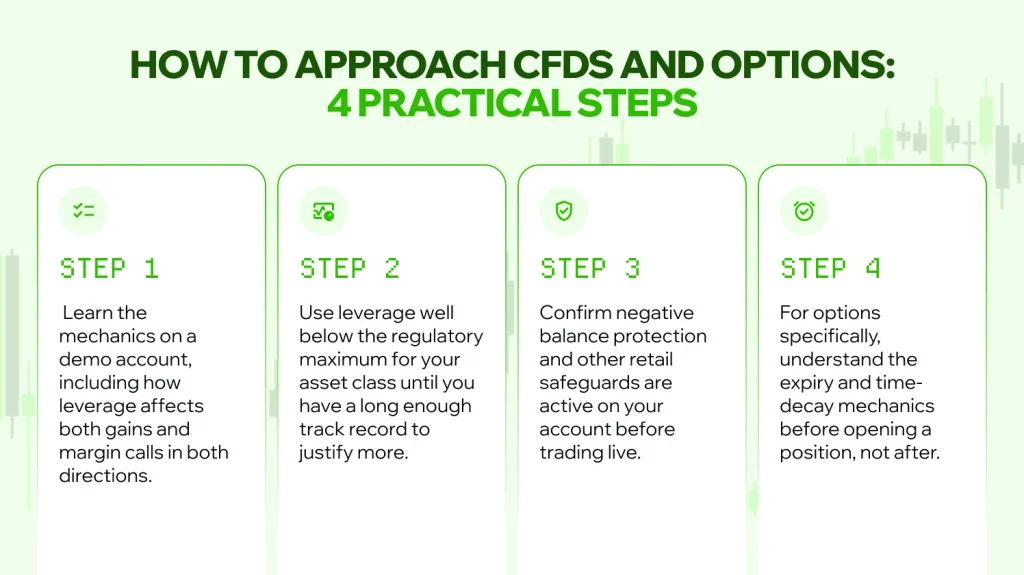
If you’re starting out, learn the mechanics on a demo account first, including how leverage affects gains, losses, and margin requirements when the market moves against a position. And when you go live, remember that lower effective leverage reduces exposure, while a longer track record does not remove leverage risk.
Before you trade with real money, confirm that negative balance protection and other retail safeguards are active on your account. For options specifically, understand the expiry and time-decay mechanics before opening a position, not after.
Are CFDs and options worth trading? Weighing it honestly
The advantages are real. CFDs give you flexible, capital-efficient access to a wide range of markets from one account, including the ability to go short as easily as long. Purchased options and defined-risk option spreads can give you ways to express a view or hedge a position with a known maximum loss, when you understand how they work.
But the limitations are real too. Leverage cuts both directions, which is exactly why regulators in jurisdictions including the EU and UK capped it by asset class rather than leaving it entirely to broker or trader discretion. Options add a time dimension that’s easy to underestimate, while some option-selling strategies can expose traders to substantial or theoretically unlimited losses. And both products reward specific knowledge that a single “what is” video can introduce but can’t replace.
CEO & Co-Founder, Versus Trade – Vitalii Bulynin
(paraphrased from FXStreet interview, July 15, 2026)
“Choose a broker as a vehicle, not a savings account: the platform should get your money in and out fast, typically within a couple of minutes, and that matters as much as the product you’re trading on it.”
Vitalii Bulynin, CEO & Co-Founder, Versus Trade (paraphrased from FXStreet interview, July 15, 2026)
Conclusion: let the regulation set your starting point
The “stop trading CFDs” and “smart investors trade CFDs” camps are both citing real trade-offs, and both are talking past the fact that regulators in several major jurisdictions set retail leverage limits by asset class years ago. Start with the applicable regulatory caps as your ceiling (not your target), confirm negative balance protection is active, and treat options’ time decay with the same respect you’d give leverage. The guardrails regulators put in place exist for a reason. Use them.
Risk disclaimer: CFDs are high-risk instruments, and leverage can rapidly amplify losses. Available protections depend on the broker and jurisdiction. This article is educational content, not financial advice.
Try strategies, explore MT5 and get a feel for the markets with a demo account before putting real capital on the line.

Note on sourcing: citations appear inline next to the claim they support. Video citations are based on each video’s title and description, not verbatim transcripts. Leverage and account-protection figures are drawn from ESMA’s binding product intervention measures on CFDs, effective 1 August 2018. The Versus Trade reference is paraphrased from a named, on-record interview (FXStreet, July 15, 2026), since the original remarks were reported in indirect speech.
- What are CFDs?
- What is options trading?
- The regulation that exists because of this exact debate
- The warnings vs. the advocacy
- What Indonesian traders are watching
- Common mistakes with CFDs and options
- How to approach CFDs and options responsibly
- Are CFDs and options worth trading? Weighing it honestly
- Conclusion: let the regulation set your starting point