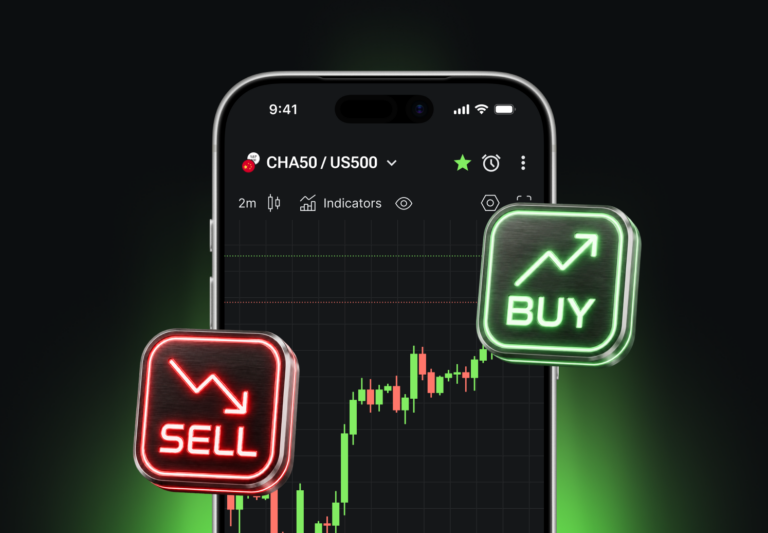
A Thai trader watching gold, the US 500, and USD/THB may see several opportunities at once. A single trading account offering contracts for difference provides exposure to these movements without purchasing the assets themselves.
That distinction sits at the centre of the advantages of CFD trading over normal trading. CFDs can provide broad market access, straightforward short selling, and lower upfront capital through leverage. They can also generate rapid losses, carry overnight financing, and provide no shareholder ownership.
The CFD vs. direct ownership choice depends on the time horizon, market view, and risk budget, including whether CFD exposure is better than stocks for the intended strategy.
CFD Trading vs Normal Trading: Two Different Types of Exposure
A CFD trade is an agreement between a trader and a broker to exchange the difference between the opening and closing value of a market position. The trader does not receive the share, currency, barrel of oil, or ounce of gold represented by the contract.
With traditional trading, the transaction generally involves purchasing the relevant security or asset. A shareholder may receive voting rights and dividends, while an investor holding an exchange-traded fund owns units in the fund. These rights do not accompany a CFD because there is no ownership of the underlying.
The difference between the structures becomes visible at closure. With a single CFD, the profit or loss is based on the price change, direction, size, and costs. In share trading, the investor sells the shares previously bought.
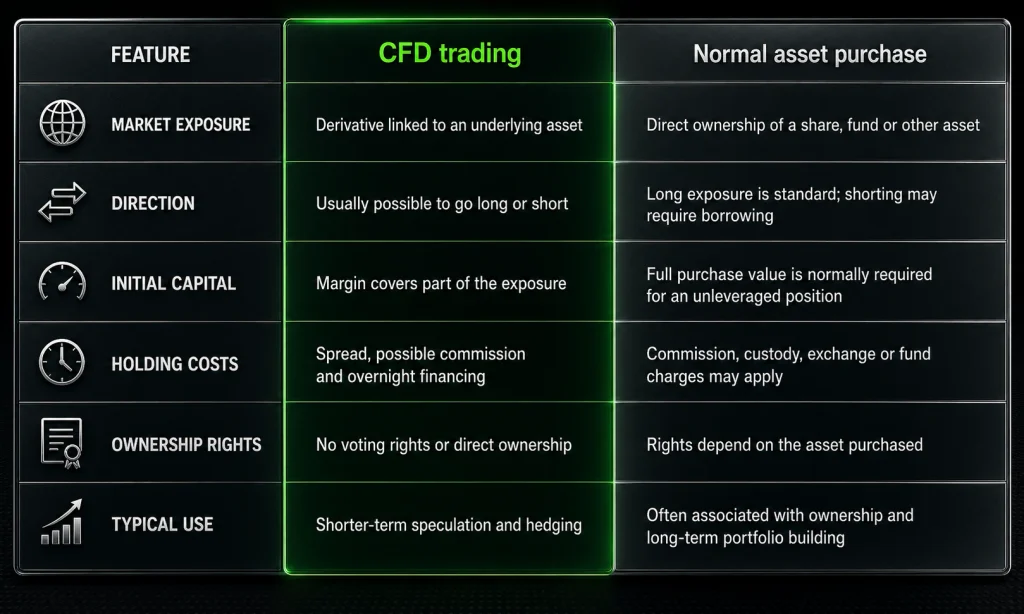
CFD trading with traditional trading can appear within the same strategy, combining owned shares with a shorter CFD position.
Readers exploring trading online can encounter two economically different activities behind similar interfaces.
The Benefits of CFD Trading
CFD trading provides exposure to price movements without purchasing the asset, which is one of the main benefits of CFD trading.
Markets move fast. Get the flexibility to adjust your exposure and trade opportunities your way with leverage up to 1:2000.
Lower Capital Requirements Through Leverage
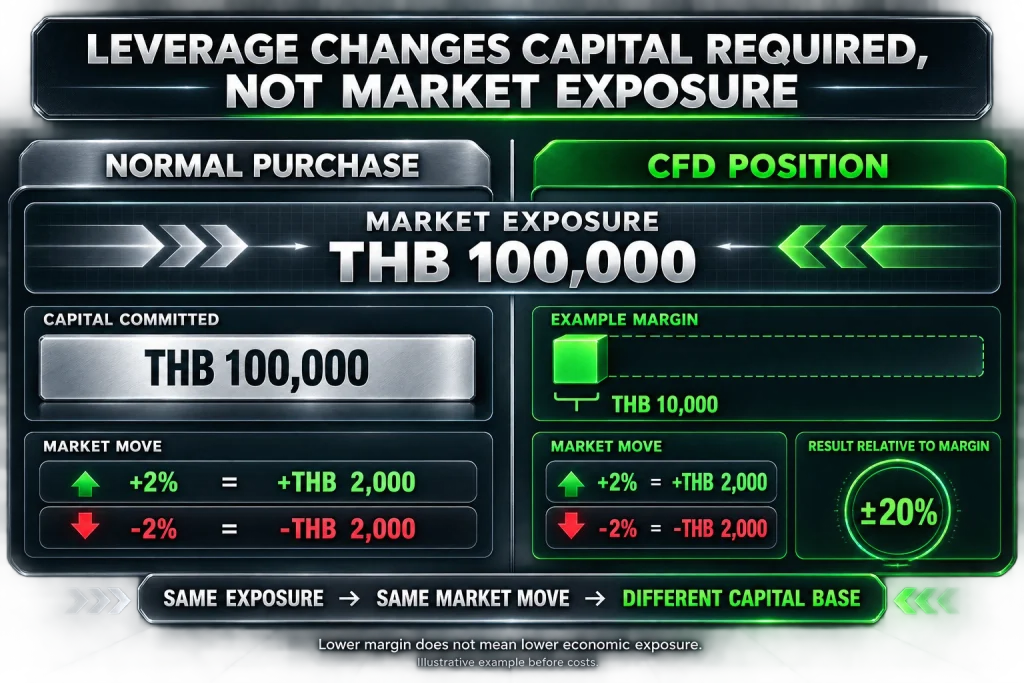
Cash stock trading normally ties the purchase amount to the value of the shares. A THB 100,000 unleveraged position requires approximately THB 100,000 before transaction charges. A leveraged CFD position may require only a fraction of its total exposure as margin.
This allows a trader to control a position with a smaller initial deposit. It increases capital efficiency, not reduces economic risk. On THB 100,000 of exposure, a 2% market move represents THB 2,000 before costs regardless of the margin deposited.
With THB 100,000 of exposure and THB 10,000 in margin, a 2% move produces a THB 2,000 gross gain or loss before charges, equal to 20% of the margin. The mechanism that creates potential profit also magnifies potential losses. A broker may close the position when available margin falls below the required level, subject to its rules.
PR & Brand Director, Versus Trade — Darya Ivanova
The Ability to Trade Rising and Falling Markets
Buying a share usually expresses a bullish view. The buyer benefits when the market rises and loses when it falls. Traders seeking to profit from a decline may need borrowed shares, a margin account, or another derivative.
CFD trading allows a directional position to be opened more directly:
- A long position seeks to benefit from a rise in the price of an asset.
- A short position seeks to benefit from a fall.
- The resulting profit or loss depends on the size and direction of the move, less applicable costs.
CFD trading gives traders directional flexibility, but only if the market forecast is correct. This ability to profit from both rising and falling markets is frequently cited among the key advantages of CFD trading. It does not mean that a trader will predict the move successfully. A short CFD loses money when the market rises, just as a long CFD loses when it falls.
Multiple Markets From One Platform
Modern CFD trading platforms may group forex, indices, metals, energy markets, cryptocurrencies, and share CFDs, giving traders access to multiple markets from a single interface. A single trading platform can therefore provide access to global markets. This is because it does not require separate software for each asset class.
A wide range of CFD instruments may include:
- currency pairs and index CFDs;
- gold, silver, oil and other commodity markets;
- share and cryptocurrency CFDs, where offered;
- relative-value instruments linked to two different assets.
Product ranges, specifications, and leverage depend on the broker and jurisdiction.
The MT5 web terminal provides browser-based access where supported, bringing charts, orders, and account information into one interface. Platform convenience does not alter the risk attached to the contract.
Why Trade CFDs?
Shorter holding periods often expose the practical advantages of CFD trading more clearly. The answer to why trade CFDs usually lies in the ability to speculate on the price, trade multiple markets from one account, respond to markets that are rising or falling, and adjust position size without arranging delivery or custody. The structure stays focused on price exposure, not the voting rights, dividends, or compounding associated with long-term investing.
Explore the Versus Trade platform and discover the tools traders use to analyze markets, manage risk, and improve performance.

Trading Costs Can Be Lower, but Not in Every Case
Claims that CFD costs are always lower than traditional trading flatten several charges into one comparison. A CFD position may avoid custody expenses or certain asset-transfer taxes because there is no purchase of the underlying. That does not make the position free.
Common trading costs associated with CFD trading include:
- the bid-ask spread
- a separate commission on some instruments
- currency conversion charges
- overnight fees
- market-data or inactivity fees where applicable
An intraday index trade may cost less than arranging and financing a conventional short sale. A share CFD held for months can become more expensive because daily financing accumulates. Direct ownership may therefore be more economical over a long period.
How Long Should I Hold a CFD Position?
A CFD has no universal ideal holding period. Some CFD traders close positions within one session, while others keep them open for several days or weeks. The practical limit is shaped by the original market thesis, market volatility, and the cost of maintaining the position.
Time becomes a direct expense when positions overnight attract financing. A trade held for several hours may incur only the spread and any commission. The same position held for weeks can accumulate financing charges large enough to alter its expected return. Weekend financing and the broker’s rollover schedule also matter.
A holding period remains viable only while the price action fits the original scenario, financing has not made the trade uneconomical, and no predefined exit has been reached. Time alone does not make a position safer. Long-term investment is different: fully paid shares can remain in a portfolio without daily leveraged financing, while CFD costs may continue until closure.
Real entry and exit costs can widen during low liquidity, announcements, or abrupt market moves, while slippage can move execution away from the requested level.
A trading demo account can illustrate margin and orders under simulated conditions but cannot reproduce live liquidity, slippage, or emotional pressure.
The Risks of CFD Trading Travel With the Advantages
The pros and cons often come from the same feature. Leverage makes exposure capital-efficient, but trading with high leverage leaves less room for an adverse move. Short positions give you access to declines but lose when the market rises.
Leverage Multiplies Profits and Losses
Leverage lets traders control larger exposure but magnifies profits and losses relative to committed capital. Several correlated CFD positions can also represent one concentrated market view despite using different symbols.
An American billionaire hedge fund manager — Paul Tudor Jones,
Market Wizards: Interviews with Top Traders, 1989, New York Institute of Finance.
How Can I Manage Risk in CFD Trading?
Risk control begins before a trader selects “Buy” or “Sell.” The relevant number is not only the margin required to open a CFD but also the amount that could be lost if the market reaches the planned exit. A small margin deposit can represent much larger exposure.
A structured process usually includes:
- Define the loss limit. Risk per trade remains separate from the account balance and reflects what the trader can afford to lose.
- Calculate the position size. Contract size, stop distance, and value per point determine monetary risk.
- Set the exit before entry. Stop-loss orders establish a planned exit, although gaps and slippage can change execution.
- Measure combined exposure. Different symbols may respond to the same market driver.
- Monitor margin and financing. Available margin and overnight financing can change while a position is open.
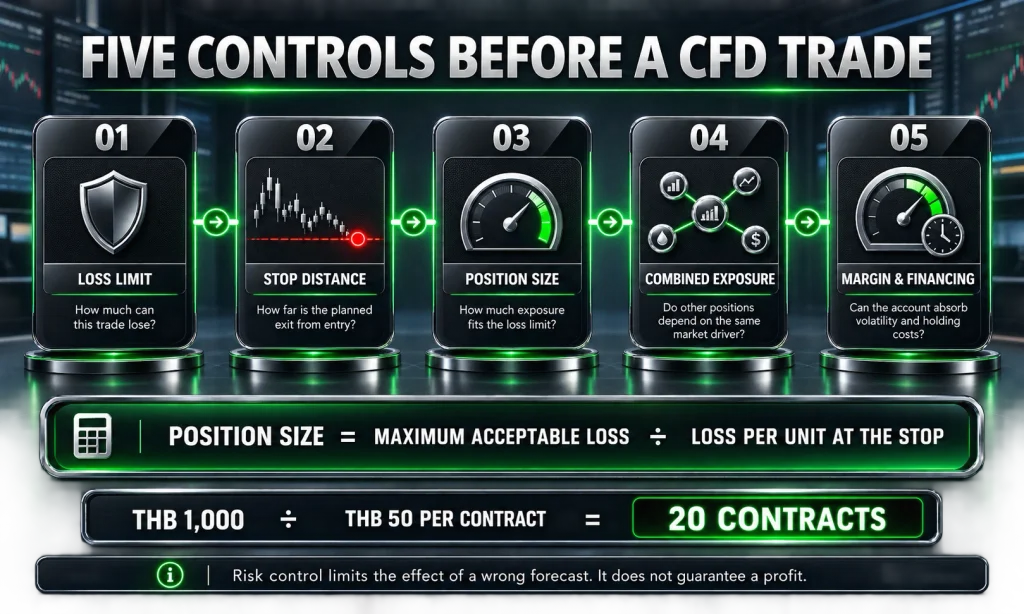
A simple sizing calculation is:
Position size = maximum acceptable loss ÷ loss per unit at the stop level
An acceptable loss of THB 1,000 divided by THB 50 of risk per contract produces 20 contracts before slippage and charges. Risk management cannot guarantee CFD profits. It limits how strongly one incorrect forecast can affect the account.
The Trader Does Not Own the Asset
Price exposure is not asset ownership. A trader who buys a share CFD normally has no voting rights and is not entered on the company’s shareholder register. Cash adjustments may reflect dividends, but they are contractual adjustments rather than dividends paid to a direct shareholder.
This makes CFDs poorly aligned with some trading goals. A long-term portfolio may prioritize ownership and income, while a short macro trade may value directional access and margin efficiency.
CFD Trading in Thailand
Thailand has a domestic derivatives market through the Thailand Futures Exchange, but its exchange-traded products are not the same financial instrument as an OTC CFD. In 2026, the Thai SEC expanded permissible derivatives underlyings while developing related supervisory rules. This is not blanket approval of every offshore CFD provider.
Thai residents interested in trading need to identify the account entity, its regulator, and whether it accepts Thai clients. Bank of Thailand rules may affect outward transfers, while tax treatment depends on current rules and personal circumstances.
Thailand has relaxed parts of its overseas-investment framework, but broker regulation differs from permission to solicit clients locally. Current Thai SEC and Bank of Thailand information carries more weight than a generic claim that CFDs are simply legal in Thailand.
For desktop access, MetaTrader PC can provide charting and order management. Regulation and contract terms belong to the broker entity, not the software.
Are CFDs Worth It Compared With Normal Trading?
Whether CFD trading is worth it depends on its purpose. Unlike traditional trading, its flexible exposure across asset classes may suit experienced traders using shorter horizons and predefined risk.
They may not be suitable for someone seeking direct ownership, dividend income, or a passive portfolio. The decision depends on goals and risk tolerance, available capital, expected costs, and familiarity with order types and powerful trading tools. Only money available for speculative risk belongs in leveraged CFD trading activities.
The case for CFD trading over normal trading is strongest when flexibility matters more than owning the underlying. Direct ownership fits more naturally when income and a long holding period take priority.
Lower initial margin does not mean lower economic exposure. Trading involves a high level of risk, and it is important to understand the risks before you start trading CFDs and open a live position.