- What Is a Futures Contract and What Does It Represent?
- What Is Futures Trading?
- How Margin and Leverage Change Futures Risk
- Which Commodity Contracts Trade on the Futures Market?
- Why Do Companies and Traders Use Futures?
- Futures vs Forwards, Options, and CFDs
- What Do the Numbers in a Futures Contract Mean?
- What Should a New Futures Trader Check Before Opening a Position?
- Is Trading Futures Suitable for Every Trader?
A price chart reveals little about the machinery behind a trade. Gold may move by only a few dollars, yet that change can produce a much larger gain or loss than a new trader expects. Contract size, tick value, and leverage turn the movement on the screen into money.
A futures contract is a standardized derivative that commits a buyer and seller to a transaction involving an underlying asset on a future date. That asset might be a physical commodity, a currency, an interest rate, or a stock market index. The same financial instrument can support speculation, commercial risk management, or a portfolio hedge.
CEO, Versus Trade — Vitalii Bulynin
That observation from Vitalii Bulynin captures a part of contract trading that is easy to miss. Behind the chart sit the futures exchange, clearing process, broker, trading platform, and margin system.
What Is a Futures Contract and What Does It Represent?
A futures contract represents a standardized agreement to buy or sell a commodity or financial instrument under terms established by an exchange. In common shorthand, futures are contracts to buy or sell an asset at a predetermined price on a specific future date.
The definition can sound as if every contract ends with a shipment. Most traders close their futures position before expiration, while many financial contracts use cash settlement from the outset.
The Terms Written Into Every Contract
Each contract specification identifies the underlying asset, contract size, quotation method, minimum price movement, expiration date, and settlement procedure. These terms are standardized, so participants do not negotiate them every time they trade.
The future price is the market price of a particular contract month. It does not have to match the current cash price of the underlying. Storage expenses, financing costs, interest rates, supply and demand, and the time remaining until expiration can affect the price of a futures contract.
A crude oil futures contract represents a fixed quantity and grade of petroleum. A gold futures contract has its own contract unit and tick size. Stock market index futures use a multiplier to turn changes in index points into a monetary value.
Cash Settlement and Physical Delivery Are Not the Same
Physical settlement transfers the underlying commodity according to the exchange’s delivery rules. Cash-settled futures replace delivery with a final financial adjustment based on a reference value. Index futures generally use cash settlement because an index cannot be delivered.
Physical delivery remains important for commercial procurement and price convergence, but relatively few speculative commodity futures positions reach that stage. Selling the contract closes an existing long position. Buying an equivalent contract closes a short one. The transaction removes the market exposure rather than canceling the exchange’s rules.
What Is Futures Trading?
Futures trading is the buying and selling of standardized contracts whose value follows an underlying asset, rate, or index. The participant does not usually pay the full notional amount or take immediate ownership of the asset. A position is opened with margin, while profit and loss change with the contract price.
A participant expecting the market to rise can buy a futures contract and open a long position. Someone expecting a decline can sell a futures contract and hold a short position. Commercial firms use the same futures market to hedge prices they already face elsewhere. An airline may hedge fuel costs, while a palm oil producer may seek protection against a fall in selling prices.
Most futures transactions are closed before expiration. Contracts held longer may be rolled into another month or taken to settlement, depending on the trading style and contract terms.
How Does Futures Trading Compare to Stock Trading?
Stock trading normally transfers an ownership interest in a company. A shareholder may receive dividends and voting rights, depending on the class of shares. Trading futures contracts creates price exposure without making the participant a shareholder or owner of a physical commodity.
The funding structure also differs. Buying shares without leverage generally requires payment of their full market value. Futures use margin to control a larger position, so relatively small market movements can have a stronger effect on the trading account. Futures contract costs, expiration dates, contract multipliers, and settlement rules are not features of ordinary share ownership.
Short exposure is another distinction. Selling stock short usually requires borrowed shares and may involve borrowing fees. A futures trader can open a short position by selling a contract directly. Stock trading is commonly associated with ownership and longer holding periods. Futures trade activity is often tied to hedging, leverage, or shorter-term exposure to a commodity, currency, rate, or index.
What Happens to the Trader After an Order Is Filled?
The process is consistent across regulated futures exchanges:
- The trader selects the contract, expiration month, and order type.
- The order is matched with an opposing order on the futures exchange.
- The margin requirement is reserved in the futures account.
- The account gains or loses value as the contract price moves.
- The position is closed, rolled into a later month, or held to settlement.
Futures contracts are traded through offsetting transactions when an early exit is required. Selling the contract closes a long position. Buying the same contract month closes a short one. Selling a different month would create another position rather than close the first.
Open futures positions are also marked to market. The exchange establishes an official daily settlement price, and gains or losses are reflected through the settlement process. A trader does not simply wait until expiration for the entire result to appear.
Try strategies, explore MT5 and get a feel for the markets with a demo account before putting real capital on the line.
How Margin and Leverage Change Futures Risk
A futures position can control a market value far larger than the cash committed to the trade. This makes futures capital-efficient. It also means an underfunded account can lose money quickly.
Margin in Futures Trading Is Collateral, Not a Purchase Price
Margin is collateral supporting a contract, not a down payment that creates partial ownership of the underlying asset. Initial margin is required to open the position. Maintenance margin is the lower level the account must continue to meet.
The exchange establishes margin levels, while a broker may require more. Requirements can also rise when volatility increases. No permanent percentage applies to every futures trading account or every trading day.
If a contract has a notional value of $50,000 and requires $5,000 in collateral, a 2% change in the value of the futures contract equals $1,000 before costs. That is 2% of the exposure but 20% of the posted collateral. Leverage changes the effect of a price movement on account capital, not the movement in the price of the underlying asset.
A One-Tick Move Can Be Worth More Than It Looks
The monetary result depends on three numbers:
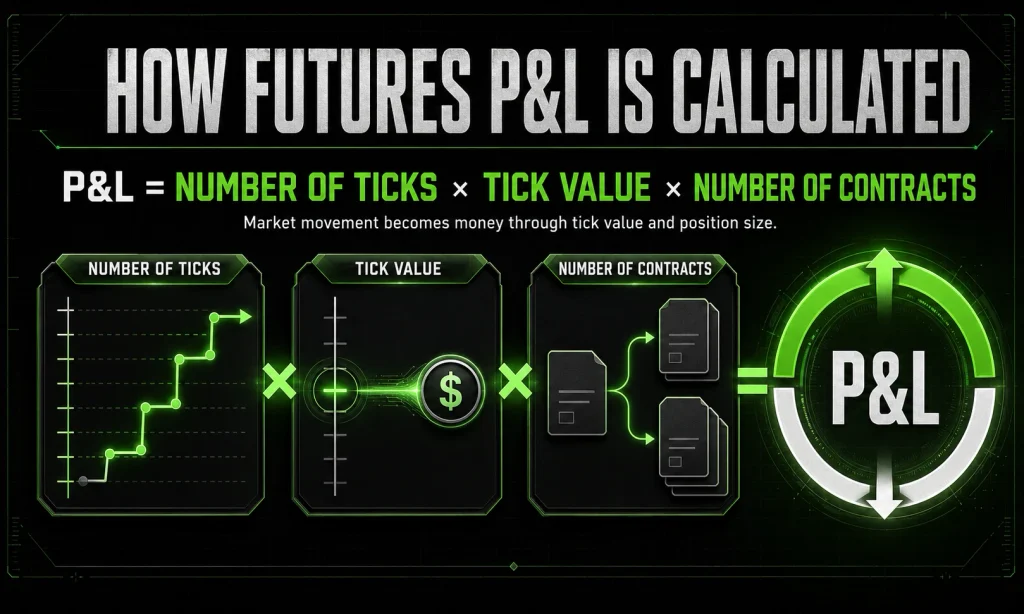
If one tick is worth $10 and the market moves 12 ticks, one contract gains or loses $120. A second contract doubles the result. The chart covers the same distance, but the account experiences twice the change.
Billionaire hedge fund manager — Paul Tudor Jones
Market Wizards: Interviews With Top Tradersz
The observation fits futures particularly well. A correct prediction may still end badly when a position is too large to survive normal volatility. Stops can define planned risk, but gaps and thin market liquidity can produce execution beyond the requested price.
Which Commodity Contracts Trade on the Futures Market?
The futures market covers energy, metals, agricultural goods, currencies, bonds, interest rates, cryptocurrencies, individual stocks, and equity indices. Each group responds to a different mix of policy, supply, demand, and trading volume.
Commodity Futures Follow Physical Supply and Demand
Commodity futures connect financial markets with commercial procurement. Oil producers, refiners, airlines, food companies, miners, and agricultural businesses use futures to manage prices that affect future sales or operating costs.
Crude oil can react to inventories, refinery demand, transport disruptions, and production policy. Coffee and cotton carry weather and harvest risk. Gold futures respond to physical demand, currency movements, real yields, and changes in risk appetite.
Malaysia provides a useful example. Bursa Malaysia Derivatives’ Crude Palm Oil Futures contract has a contract size of 25 metric tons. Producers, processors, exporters, and traders can use it for price discovery and hedging without every participant buying physical palm oil.
Market access varies by provider. A platform may list exchange futures, a CFD referencing futures prices, or a spot-derived product. Anyone looking to trade commodity markets therefore needs the symbol specification, not just a familiar name.
In the United States, these markets are regulated by the Commodity Futures Trading Commission. Malaysia has its own framework, with Bursa Malaysia Derivatives operating the domestic futures and options exchange.
Index Futures Turn a Benchmark Into One Position
An index is a calculated benchmark rather than a physical asset. Index futures convert its price movement into a cash-settled financial instrument through a contract multiplier.
S&P 500 futures track expectations around the S&P 500, while E-mini S&P 500 futures offer a smaller contract than the traditional full-sized product. Neither creates ownership in the shares of the index’s constituent companies.
Malaysia has its own exchange-traded example. The FTSE Bursa Malaysia KLCI Futures contract uses the FBM KLCI level multiplied by MYR50. Its minimum price fluctuation is 0.5 index points. A portfolio manager can sell the contract to offset part of a decline in Malaysian equities, although the hedge will be imperfect when the portfolio does not closely resemble the benchmark.
Products available through trade global stock indices may use another structure, including CFDs. Contract size, expiration, rollover, and settlement policies reveal whether an instrument is an exchange future or a broker-provided derivative.
Currency, Bond, and Interest Rate Futures Price Different Risks
Currency futures provide exchange-traded exposure to exchange rates, whereas retail forex commonly operates through an over-the-counter dealer or broker model. Bond futures and interest rate futures react to changes in yields and monetary-policy expectations. Their underlying references may include a government bond, a United States Treasury security, or a short-term interest rate.
Stock futures and cryptocurrency futures are also available in some jurisdictions. Availability and regulatory treatment vary, so a familiar asset name does not make every contract interchangeable.
Futures bring leverage, hedging, and price discovery into one market structure. Explore the available commodity and index instruments with Versus Trade, then establish whether each symbol is a futures contract, CFD, or another derivative before opening a position.
Trade XAUUSD with spreads from 2.4p and zero commission per lot. When gold moves, trading costs shouldn’t steal the spotlight.

Why Do Companies and Traders Use Futures?
The reasons futures markets exist become clearer in the physical economy. Businesses face prices they cannot control. Investors hold portfolios that can lose value during a broad market decline. The use of futures contracts transfers part of that financial risk to participants willing to take the other side.
Producers and Buyers Use Futures to Hedge Prices
A coffee producer worried about falling prices can sell futures contracts before the crop is ready. A commercial buyer concerned about rising costs can buy contracts. If the cash price later moves against the business, the futures hedge may offset part of the damage.
The result is rarely perfect. Product quality, delivery location, timing, and changes in the relationship between cash and futures prices create basis risk. Futures to hedge an exposure can reduce uncertainty, but they do not guarantee a favorable final price.
A Portfolio Manager Can Hedge an Equity Index
An investor expecting temporary weakness may not want to sell a stock portfolio, incur costs, and rebuild it later. Selling index futures can create a short overlay. Losses in the shares may then be partly offset by gains in the futures position.
The hedge depends on the portfolio’s sensitivity to the benchmark. A technology-heavy account will not necessarily move in line with the S&P 500 or FTSE 250 Index. Position sizing remains essential.
Futures vs Forwards, Options, and CFDs
Futures, forwards, options, and CFDs can all produce exposure to an asset without immediate ownership. Their obligations and infrastructure differ.
Where Futures and Forward Contracts Separate
The distinction between forwards and futures begins with standardization. A forward contract is usually negotiated over the counter. Its parties can customize the quantity, maturity, settlement, and delivery terms.
Futures use exchange-defined specifications and centralized clearing. This generally provides greater price transparency and easier offsetting, but participants must use the available contract sizes and months. Both futures and forward agreements create obligations for the buyer and seller.
Futures and Options Do Not Create the Same Obligation
Options contracts give the buyer a right, but not an obligation, to buy or sell under defined terms. The seller accepts the corresponding obligation. With futures, both sides assume contractual duties.
Futures options, also called options on futures, use a futures contract as their underlying. The option buyer pays a premium, while futures margin serves as collateral. Combining options and futures can reshape risk, but it does not make the resulting position simple or automatically safe.
A Futures Contract and a CFD May Follow the Same Market Differently
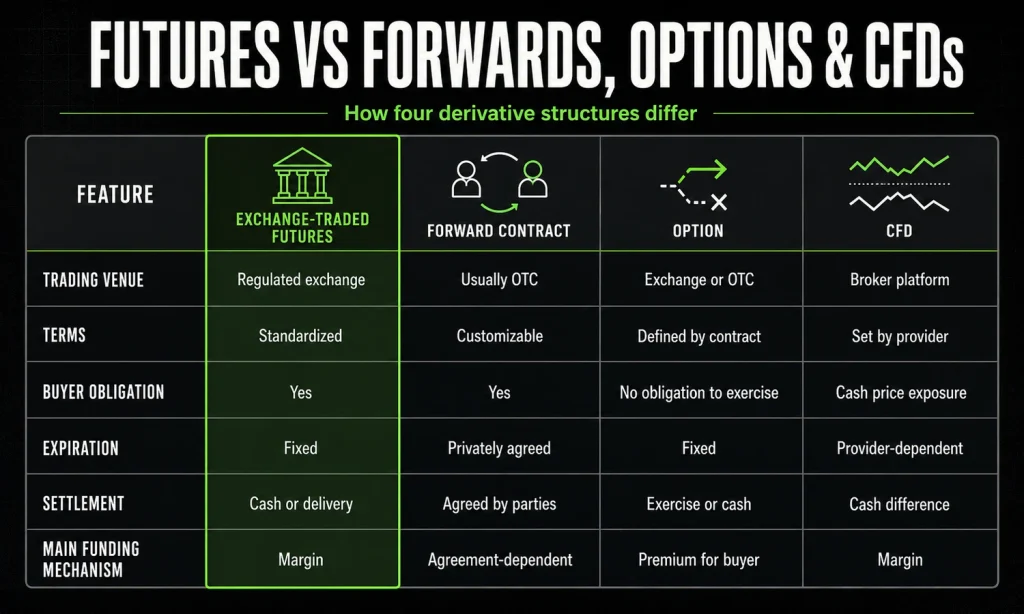
A CFD may follow the same gold, oil, or index market as a future, yet its counterparty structure, costs, rollover rules, and trading hours can differ. Similar charts do not make them the same trading instrument.
What Do the Numbers in a Futures Contract Mean?
Contract specifications turn price movement into money. Without them, the apparent size of a trade says little about the risk.
A Simplified Gold Futures Example
The figures below describe a hypothetical small contract, not a current exchange product or an offer from Versus Trade.
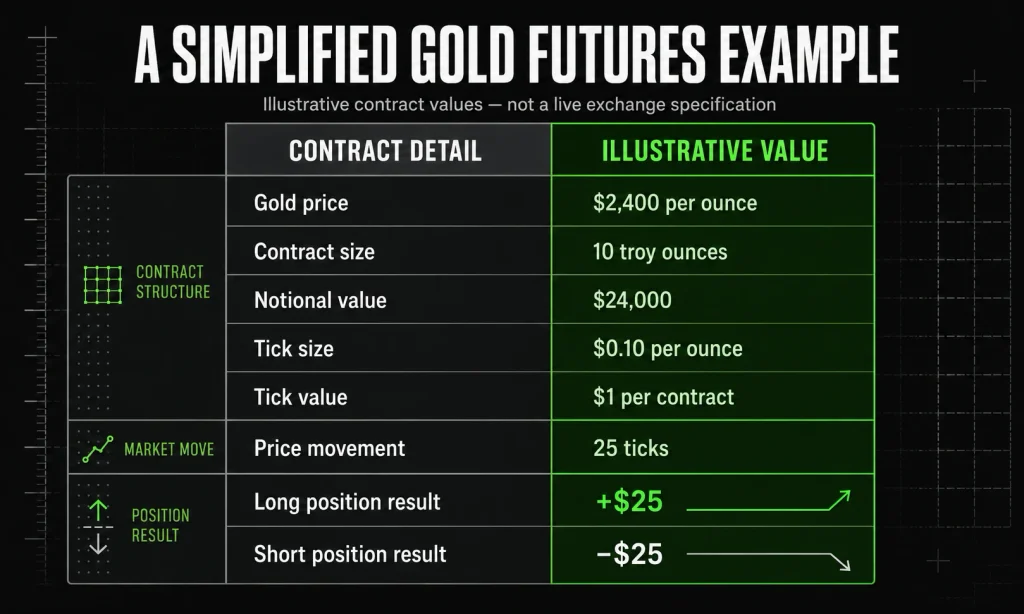
The example shows why buying and selling futures cannot be sized from the deposit alone. Futures are priced per unit of the underlying, while the contract multiplier determines the total exposure.
What Should a New Futures Trader Check Before Opening a Position?
A futures trader usually gets more useful risk information from the specification sheet than from another technical indicator.
Read the Contract Specification Before the Chart
The core fields include:
- The underlying asset, contract size, quotation method, tick size, and tick value.
- The expiration date, final trading day, settlement method, trading hours, and margin requirement.
- The exchange, contract month, trading volume, liquidity, and broker-specific costs.
Some major contracts trade nearly 24 hours a day during the business week, but maintenance breaks, holidays, and product-specific sessions still apply. Thin periods can bring wider spreads and poorer execution.
Match Position Size to the Futures Account
Position size begins with an acceptable monetary loss, followed by stop distance and tick value. If the planned risk is $200, the stop is 10 ticks away, and each tick is worth $20, one contract uses the full allowance.
A futures trading account also needs free capital beyond the opening requirement. Adverse movement, daily settlement, or a margin increase can consume that buffer. Swing trading carries overnight gap and expiration risks. Intraday trading avoids some overnight exposure but remains sensitive to news and sudden changes in liquidity.
Confirm What the Trading Platform Actually Offers
A provider can offer futures alongside spot instruments, CFDs, or options on futures. The symbol specification should identify the contract size, expiration, financing or rollover method, and settlement model.
Traders can access global markets with MT5 WebTrader, but MT5 is an interface rather than proof that every listed symbol is an exchange-traded future. Product terms determine what is being traded.
Malaysia’s Capital Markets and Services Act provides the licensing framework for capital-market intermediaries. Bursa Malaysia Derivatives maintains its own exchange rules and contract specifications. The distinction between a chart and the business behind it also appears in Why Fintech Careers Are Still Misunderstood in Malaysia — And What Candidates Discover Too Late, which examines the less visible side of Malaysia’s financial technology sector.
Is Futures Trading Halal?
Futures trading is not automatically halal or haram solely because it uses a derivative contract. The assessment depends on the underlying asset, contract structure, purpose of the transaction, and presence of riba, excessive gharar, or gambling-like speculation.
Malaysia’s Securities Commission Shariah Advisory Council has accepted specific futures instruments under defined conditions. Crude palm oil futures are considered Shariah-compliant when transactions remain free from riba and gambling. Single stock futures may also qualify when the underlying shares are Shariah-compliant. Index futures can be Shariah-compliant when all constituents of the underlying index meet Shariah requirements. The conventional FKLI does not meet that condition because the FBM KLCI includes both Shariah-compliant and non-compliant securities. Conventional interest rate futures raise a separate riba concern.
Purpose matters as well. A genuine hedge against commercial or portfolio risk is not economically identical to an oversized speculative trade made without analysis or risk control. The Securities Commission Malaysia’s Shariah Advisory Council resolutions provide product-specific guidance, but they do not make every contract or trading strategy permissible. A personal religious assessment may still require a qualified Shariah adviser familiar with the exact instrument.
A Short Pre-Trade Risk Check
Before a trader decides to start trading futures, four details deserve a final review:
- Planned loss comes from stop distance and tick value, not from margin alone.
- The selected contract month has usable liquidity and is not approaching expiration unnoticed.
- The instrument is clearly identified as a future, CFD, option, forward, or spot product.
- Free account capital can absorb adverse movement and a possible change in margin.
Is Trading Futures Suitable for Every Trader?
Futures can support speculation, portfolio hedging, and commercial price management. They also compress a large exposure into a relatively small capital requirement. That combination does not fit every account.
A controlled trade is based on defined risk, clear contract mechanics, and enough liquidity to enter and exit. A position taken without those controls can resemble gambling even when the initial analysis is sound. Futures and options are tools. The result still depends on how much capital is exposed and how the position is managed.
Chart access is only the beginning. Contract size, tick value, margin, expiration, and settlement determine what a position can do to an account. Explore the markets available through Versus Trade, read the complete instrument specification, and confirm the product structure before committing capital.
- What Is a Futures Contract and What Does It Represent?
- What Is Futures Trading?
- How Margin and Leverage Change Futures Risk
- Which Commodity Contracts Trade on the Futures Market?
- Why Do Companies and Traders Use Futures?
- Futures vs Forwards, Options, and CFDs
- What Do the Numbers in a Futures Contract Mean?
- What Should a New Futures Trader Check Before Opening a Position?
- Is Trading Futures Suitable for Every Trader?