
Pepsi vs Coca-Cola is a Versus Pair from Versus Trade. It is a single instrument that puts two of the best-known brands on the market against each other, letting you back the side you believe will gain more. The soda rivalry you already have an opinion on becomes one trade you can take. One instrument, one trade, only at Versus Trade.
Pepsi vs Coca-Cola: one trade, two brands
This pair is one CFD that holds two stocks at once. PepsiCo (PEP) sits as the base leg and Coca-Cola (KO) as the quote leg, so the symbol reads the way a forex pair does. Buy when you expect Pepsi to climb more than Coca-Cola in percentage terms. Sell when you expect Coca-Cola to climb more than Pepsi. You trade it inside MetaTrader 5, with its own price and its own order ticket, and behind it sit the same PEP and KO you already follow as single stocks.
Search terms like “Coke vs Pepsi,” “Pepsi vs Coke,” and “Coca-Cola or Pepsi” all point to this same pair. The order is fixed: Pepsi as base and Coca-Cola as quote. So searching for PepsiCo vs. Coca-Cola or Coca-Cola vs. Pepsi does not bring up a separate product. Backing Coca-Cola is the Sell side of this instrument. Whether you favor Pepsi or Coca-Cola as a drink, the trade is about relative stock performance.
Why trade Coke vs Pepsi instead of a single stock?
Trading PEP or KO on its own is a bet on where one share price goes against the dollar. You ask if Pepsi rises or if Coca-Cola rises. The pair asks a different question: ‘Which of the two performs better?’ The Coke vs Pepsi trade measures which stock climbs faster in percentage terms. If your read is that Pepsi has the stronger run ahead, that’s a Buy. If Coca-Cola looks set to lead, that’s a Sell.
Putting the same relative view into the market without this pair means opening two positions, going long one stock and short the other, sizing both, and meeting the margin requirement for each. The pair carries the view in one order on one instrument. And because Versus Trade built it in-house, you won’t find it at another broker. Leverage and relative moves work in both directions, so a wrong read can lose as easily as a right one can gain.
How the Pepsi vs Coca-Cola price works
The pair’s price is Pepsi’s price divided by Coca-Cola’s. If it prints around 2.3, one PepsiCo share is worth about 2.3 Coca-Cola shares at that moment. What moves that number is the percentage gap between the two stocks, not the raw dollar move.
Here’s the part that catches people out. Suppose both stocks add the same few dollars in a session. A three-dollar move on a sixty-dollar stock is a 5% gain, while the same three dollars on a one hundred fifty-dollar stock is only 2%. The dollars matched; the percentages did not. The lower-priced stock posted the bigger percentage gain. The pair rises if that stock is the base and falls if it is the quote. When both stocks move by the same percentage, the pair sits roughly flat.
Profit or loss is calculated in the quote leg first, then shown in your account currency, so you always read the result in the currency your account uses. The PEP stock price and the KO stock price are the two feeds behind the instrument, the same numbers you track as single stocks. Watch the Pepsi stock price against the Coca-Cola stock price, and you’re watching the percentage gap the pair trades on.
Try strategies, explore MT5 and get a feel for the markets with a demo account before putting real capital on the line.

Versus Pair Calculation
A versus pair is calculated as the price of the first instrument divided by the price of the second instrument:
Pair Value = Instrument A Price ÷ Instrument B Price
Example:
Pepsi = $150
Coca-Cola = $75
Pepsi/Coca-Cola = 150 ÷ 75 = 2
If Pepsi decreases by 4% and Coca-Cola increases by 2%:
- Pepsi: $150 → $144
- Coca-Cola: $75 → $76.50
- New pair: $144 ÷ $76.50 = 1.8824
Therefore, the pair decreases by approximately 5.88%, rather than exactly 6%, because the percentage changes are applied to each instrument’s price before calculating the new ratio.
Pepsi and Coca-Cola side by side
That relative logic is what makes the story worth trading. Both Pepsi and Coca-Cola sell soft drinks the world knows, and both are steady, cash-generating businesses. That tends to make this one of the steadier Versus Pairs, with more predictable trends than a pair built on two volatile assets. It can still move against you.
Where the two differ is the mix. PepsiCo earns a large share of its money from snacks through Frito-Lay, so its results lean on food as much as drinks. Coca-Cola stays closer to a pure beverage play. Those different business mixes can cause one stock to outperform the other over a given quarter, which is exactly what the pair is built to trade.
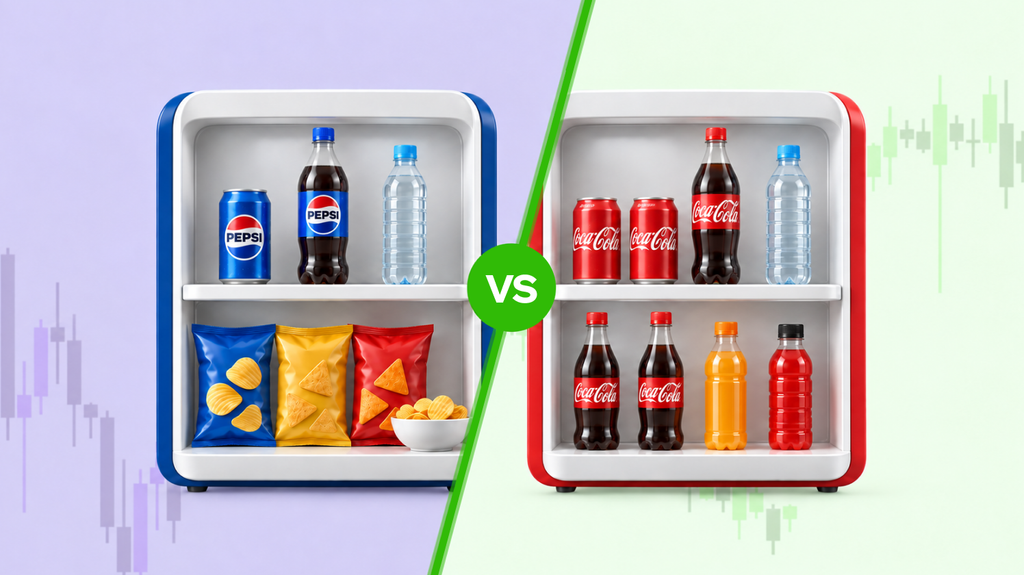
On the numbers people compare most, market cap and revenue, the two trade blows year after year. Backing Pepsi (the Buy side) fits a view that PepsiCo’s broader mix leads over your chosen timeframe. Backing Coca-Cola (the Sell side) fits a view that the focused beverage brand does a better job. If you have ever held a firm opinion on which is the better business, this is where that opinion becomes a position.
How to invest in Coke or Pepsi with a relative trade
This pair provides leveraged CFD exposure to relative share-price performance, not ownership of either company’s shares. Traders put this pair to work in three ways. Each names a side and a next step, never a price call, and each side carries risk in both directions.
Scenario 1: A brand or consumer read
Situation: You follow both beverage giants and observe one gaining stronger consumer momentum through product innovation or market share growth.
The trade: Open a Buy position if your read favors PepsiCo (backing Pepsi to outperform Coca-Cola). Open a Sell position if your read favors Coca-Cola (backing Coke to outperform Pepsi).
Action: Open it on a demo account first to see how the pair behaves, then set your stop-loss and take-profit before going live.
Scenario 2: Earnings and market share
Situation: The results season is near, and one company looks set to post stronger revenue or market-share gains than the other.
The trade: Open a Buy to back Pepsi ahead of earnings, or open a Sell to back Coca-Cola. A single trade lets you capture the performance gap between both earnings reports without opening separate stock orders.
Action: Size the position for the pair’s 1:20 leverage, set your levels, and place it on demo or live.
Scenario 3: A steadier relative trend
Situation: You want a market-neutral strategy that isolates these two consumer staples from broad market volatility.
The trade: Take the side of the stronger long-term trend – a Buy for sustained Pepsi outperformance or a Sell for Coca-Cola outperformance, and hold it as a relative position rather than a call on the whole market.
Action: Mark your entry, set a stop, and manage the position as the percentage gap plays out.
Microsoft vs Apple. Bitcoin vs Gold. Nasdaq 100 vs Oil. With Versus Pairs, you decide which side comes out stronger.

Trading conditions
- Platform: MetaTrader 5 desktop, WebTrader, and the iOS and Android apps, with the full set of MT5 tools.
- Swap-free: The entire Versus Pairs group carries no swaps, so this pair incurs no overnight swap charge.
- Leverage: 1:20 (5% margin requirement) for this stock pair. Leverage increases both potential gains and potential losses.
- Spreads: Floating and roughly in proportion to the spreads of the two underlying stocks.
- Trading hours: Operates during standard US stock market hours (09:30 to 16:00 EST / server time GMT+3) and trades only when both underlying stocks are actively quoted.
- Demo: Available on a free demo account with real-time pricing.
- Price history: Available since the Versus Trade launch in April 2024.
- Dividend Details: Because both companies pay dividends, net dividend adjustments apply on ex-dividend dates. A Buy position receives a credit for Pepsi’s dividend and a debit for Coca-Cola’s dividend. A Sell position receives a credit for Coca-Cola’s dividend and a debit for Pepsi’s dividend.
Frequently asked questions
Is “Coke vs Pepsi” the same as Pepsi vs Coca-Cola?
Yes. Coke vs Pepsi, Pepsi vs Coke, PepsiCo vs. Coca-Cola, and Coca-Cola or Pepsi are all names for this one instrument. The order stays fixed: Pepsi as the base and Coca-Cola as the quote. To back Coca-Cola, you take the Sell side rather than looking for a reversed pair.
I keep going back and forth on how to invest in Coke or Pepsi. Which side do I pick?
That’s your call to make. A view that Pepsi will outperform is a Buy. A view that Coca-Cola will outperform is a Sell. The pair gives you one position for either view, and it does not choose the side for you.
Both Pepsi and Coca-Cola stock prices rose, so why did the pair fall?
Because the pair moves on the percentage gap. If the Coca-Cola stock price gained a larger percentage than the Pepsi stock price, the pair fell even though both rose. It sits flat only when the two move by the same percentage. The same dollar amount is not enough.
Does Pepsi vs Coca-Cola charge swaps?
No. Every instrument in the Versus Pairs group is swap-free, so holding this pair overnight carries no swap charge.
Do dividends affect this pair?
Yes. Since both companies pay dividends, dividend adjustments apply on the relevant payout dates. Which way the adjustment runs depends on your side, long or short.
Can I try the pair before risking real money?
Yes. Pepsi vs Coca-Cola is available on the free demo account with live pricing, so you can test how it moves and set your risk levels before trading it live.
How much leverage applies?
This pair uses 1:20 leverage, or 5% margin requirement. That lifts both the potential gain and the potential loss on a move, so plan your position size and stops around it.
Trade Pepsi vs Coca-Cola
You have a side in this rivalry already. This pair lets you trade that view as one instrument in MetaTrader 5, with a single order in place of two positions. Open it on a free demo to get a feel for how the percentage gap moves, then take it live when your setup is ready. One instrument, one trade, only at Versus Trade.
Risk disclaimer: CFD trading carries significant risk and can lead to the loss of your capital. Leverage magnifies both gains and losses. Pepsi vs Coca-Cola is a CFD; you do not own PepsiCo or Coca-Cola shares. Dividend adjustments apply on payout dates. None of this is trading advice, and you decide which side to take.