
- What is Crude Oil vs Natural Gas?
- Why Trade Crude Oil vs Natural Gas Instead of WTI or NGAS?
- How the Crude Oil vs Natural Gas price moves
- Crude Oil vs Natural Gas: the two sides
- When to trade Crude Oil vs Natural Gas
- Crude Oil vs Natural Gas: the facts
- How crude and gas move together, and apart
- Crude Oil vs Natural Gas: FAQ
Crude Oil vs Natural Gas is a Versus Pair, a single instrument built by Versus Trade that puts WTI crude against natural gas and lets you back one side against the other. Two energy markets running on two different clocks: crude moves fast on global demand and supply news, while gas swings on weather and the seasons. In one trade, you take a side on which one climbs more in percentage terms. One instrument, one order, only at Versus Trade.
That’s the plain idea behind crude oil versus natural gas as a tradable pair. You don’t have to predict the absolute direction of either market on its own. You just pick which one you think runs harder.
What is Crude Oil vs Natural Gas?
Crude Oil vs Natural Gas (symbol WTIvsNGAS) is one CFD that combines two commodities into a single tradable price. WTI crude is the base, and natural gas is the quote, so the pair reads the way a forex symbol does: you are buying or selling crude, priced in natural gas instead of dollars.
You buy the pair when you back crude oil to rise more, in percent, than natural gas. You sell when you back natural gas to rise more than crude. That is the whole decision. The instrument name and its order are fixed, so a search like ‘natural gas vs crude oil’ points to the same pair, read from the Sell side. It’s the same product, not a separate flipped one.
You buy or sell it like any CFD. It has a live price and its own Crude Oil vs Natural Gas chart in MT5, but the product is the instrument itself; the chart just displays it. The shorthand ‘Crude Oil vs Natural Gas’ refers to the same symbol.
Why Trade Crude Oil vs Natural Gas Instead of WTI or NGAS?
Traders have always been able to buy or sell WTI on its own or trade natural gas on its own. Both are bets on one commodity’s absolute move against the dollar. If you are long crude and its price rises, the position gains value. The same principle applies to a long natural gas position. Crude oil vs. natural gas changes the question. The pair trades which of the two commodities climbs more in percent, so you are reading the gap between them, and a single-market position cannot express that.
To express that view without the pair, you would open two positions, go long on one energy market and short on the other, size both positions, and manage the margin on each. The Versus Pair puts the same relative view into one instrument and one order. Versus Trade built it in-house, and no other broker lists it. Leverage and relative moves work in both directions, so the risk is two-sided. Without the Versus Pair, however, you cannot set up the trade through a single symbol.
Try strategies, explore MT5 and get a feel for the markets with a demo account before putting real capital on the line.

How the Crude Oil vs Natural Gas price moves
So how does one price track two commodities? The pair price is calculated by dividing the crude oil price by the natural gas price. If crude trades near 70 and gas near 3, the pair sits near 23, meaning the crude oil price is about 23 times the natural gas price at that moment. What moves that number is the gap in percentage performance, not the gap in dollars.
Here is a hypothetical example to make the mechanics concrete, and it is not a forecast. Suppose both markets gain $1 on the same day. Crude climbs from 70 to 71, a rise of about 1.4%. Natural gas climbs from 3 to 4, a rise of about 33%. The dollar gain was identical, but in percentage, gas ran far ahead, so the Crude Oil vs Natural Gas price falls hard, from about 23 to about 18. The dollar gains are equal, but the percentage changes are not, and the pair reflects that difference.
Your profit and loss are calculated in the quote asset first, then shown in your account currency.
Crude Oil vs Natural Gas: the two sides
That percentage math is why the two commodities behind the pair matter so much. They rarely move to the same beat. The WTI crude oil price that many traders follow reacts quickly to broader economic developments, including OPEC supply decisions, demand data, shocks in producing regions, and movements in the dollar. When macro news breaks, the crude oil price can move within the hour.
Natural gas runs on a different calendar. Priced against the Henry Hub benchmark, it leans on weather and storage. Its drivers include cold winters that drain inventories, heatwaves that lift power demand, and the schedule of LNG export cargoes. A cold snap can send the natural gas price sharply higher while crude barely reacts. And a mild shoulder season can leave gas soft while oil trades on its own headlines.
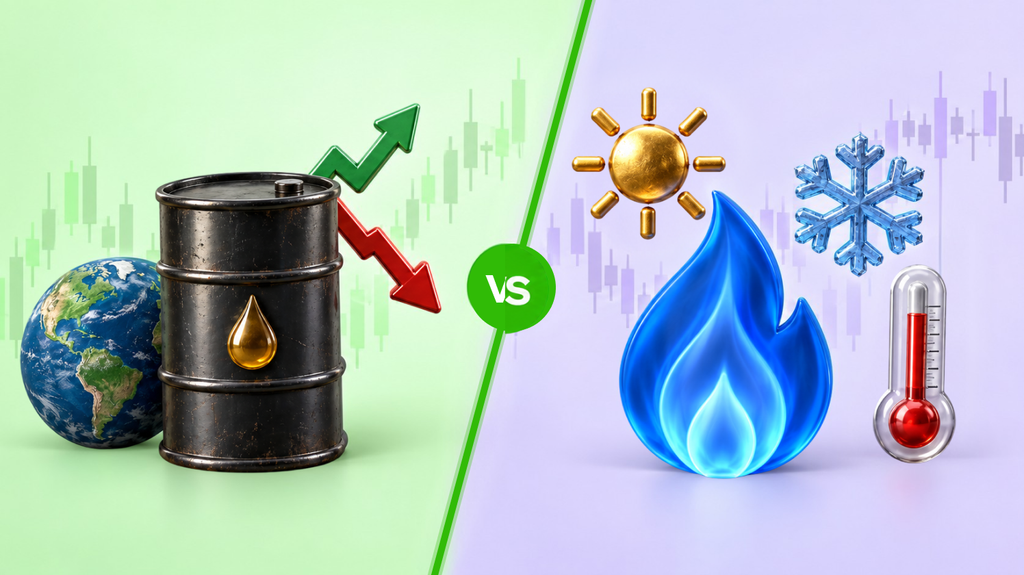
That split is the reason to take a side. Buy Crude Oil vs Natural Gas when you think crude, with its macro sensitivity, will outrun gas in percentage terms. Sell it when you think gas, on a weather or storage move, will outrun crude. You are backing the energy market you expect to lead over your chosen time frame, without needing to call an exact price for either one.
When to trade Crude Oil vs Natural Gas
The interaction between the macro and weather cycles creates several potential trading setups. Weekly inventory reports from the U.S. Energy Information Administration (EIA) also give clear timing points: the Petroleum Status Report (crude oil inventories) lands on Wednesday after 10:30 a.m. Eastern, and the Natural Gas Storage Report lands on Thursday at 10:30 a.m. Eastern. Many traders watch these releases because a bigger-than-expected draw or build can push one side of the pair harder than the other for the next few sessions.
Three examples, each ending in a side and an action, never a price call.
Scenario 1: A macroshock hits oil
- Situation: A supply headline, an OPEC decision, or a strong EIA oil inventory print on Wednesday moves the oil market, and crude starts running faster than gas, which is sitting on its seasonal footing.
- The trade: If you expect crude to gain more in percentage than gas over the next few sessions, that view is a Buy. You are backing crude’s speed on macro or inventory news.
- Action: Open Crude Oil vs Natural Gas on a demo account to test the setup or on a live account with a stop loss and take profit set to your plan.
Scenario 2: Weather lifts gas
- Situation: A cold front, a large storage draw, or a surprise number in the Thursday EIA natural gas report pushes gas higher, while crude sits quietly on a slow news day.
- The trade: If you expect gas to outrun crude in percentage while the weather or storage story runs, that view is a Sell. You are backing the second asset in the pair.
- Action: Place it on demo first to assess the pair’s behavior, then go live with a stop-loss and take-profit if it fits your plan.
Scenario 3: A longer structural view
- Situation: You hold a months-long read on the energy mix, say LNG export growth pulling gas one way or a demand cycle lifting oil.
- The trade: If weighing crude oil or natural gas for a longer hold, that view is a Buy or Sell here, one order instead of two positions. Back crude with a Buy, back gas with a Sell.
- Action: Open it on demo to watch how the percentage gap behaves over weeks, then decide on a live position with your own risk limits.
Go from registration to trading with Versus Trade in 5 minutes.

Crude Oil vs Natural Gas: the facts
- Platform: Versus Trade MT5 on desktop, WebTrader, Android, and iOS. Every MT5 chart and indicator works on the pair.
- Swap-free: No overnight swaps on this pair or on any Versus Pair.
- Leverage: 1:100, which is a 1% margin requirement.
- Spreads: Floating and broadly based on the spreads of the two underlying markets, with variations possible as market conditions change.
- Pricing: Built from the real-time crude and natural gas feeds, so any move in either market is immediately reflected in the pair.
- Trading hours: 01:05 to 23:59 server time (GMT+3), tradable only when both the crude and gas markets are open.
- Demo: Available on a free demo account with real-time pricing.
- History: Price history is available from the April 2024 launch of Versus Trade.
How crude and gas move together, and apart
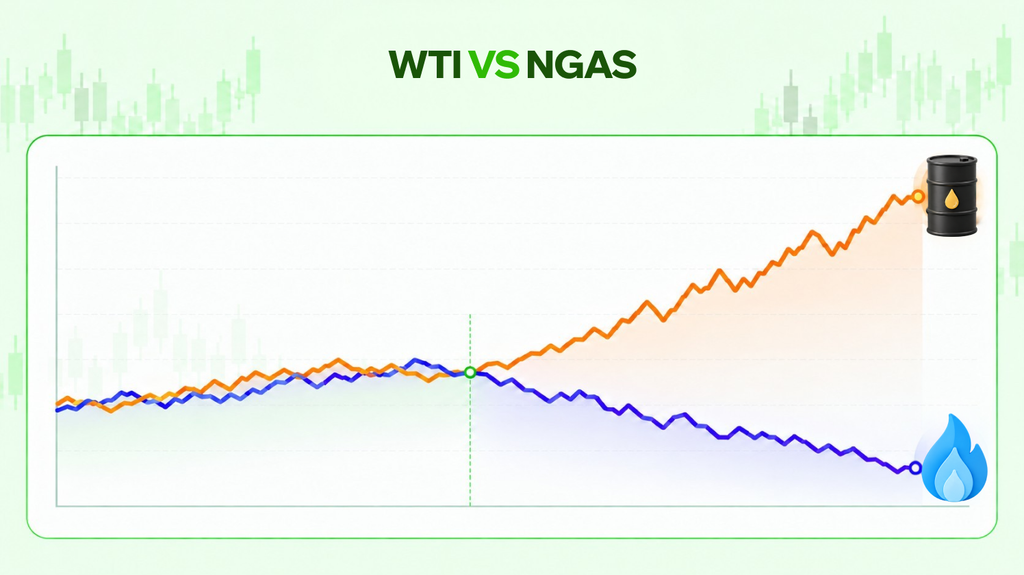
One property worth knowing before you trade it: the crude oil vs natural gas correlation does not hold steady. They answer to different drivers, so their paths cross, split, and cross again. When both markets move in the same direction by similar percentages, the Crude Oil vs Natural Gas price stays fairly calm. When one climbs while the other drops, crude oil vs natural gas volatility can spike, and that is where the largest swings and the largest risk lie.
Crude oil volatility and crude oil correlation with gas are two different things, and traders get burnt when they confuse them. A big move in crude alone can push the pair hard, even if the two markets usually track each other loosely over longer windows.
On the Crude Oil vs Natural Gas chart in MT5, you read one line: the performance gap itself. You don’t line up two separate series by eye, so there’s no natural gas vs crude oil price chart to juggle. The relationship between the two markets is already reflected in the single price.
Crude Oil vs Natural Gas: FAQ
What is Crude Oil vs Natural Gas?
It is a Versus Pair, a single CFD that puts WTI crude (base) against natural gas (quote). You trade which one rises more in percentage, not the absolute price of either. You Buy or Sell it as an instrument.
How does the Crude Oil vs Natural Gas price move?
It moves according to the percentage gap between the two markets. If crude gains more in percentage terms, the pair rises. If gas gains more in percent, the pair falls. Equal dollar moves can still shift the pair when the percentages differ.
Is Crude Oil vs Natural Gas swap-free?
Yes. The whole Versus Pairs group carries no overnight swaps.
Is there a demo?
Yes. The pair is available on a free Versus Trade demo account with real-time pricing, so you can test a side before going live.
How does leverage work on this pair?
Leverage is 1:100, which is 1% margin. Leverage magnifies both profit and losses, so size positions with that in mind.
Can I back natural gas instead of crude oil?
Yes. Backing gas to outperform is the Sell side of the same pair. A search for natural gas vs crude oil refers to the same instrument viewed from the Sell side.
Should I invest in crude oil or natural gas?
That is the view the pair expresses. The question of whether you should invest in crude oil or natural gas is exactly what one order here lets you answer. Back crude with a Buy or gas with a Sell, expressing the view through one order. The page does not tell you which side wins; you decide and manage your own risk.
How is this different from trading the crude oil price or natural gas price on their own?
A position in WTI or natural gas alone is a bet on that market’s movement against the dollar. Crude Oil vs Natural Gas bets on which of the two is stronger in one instrument instead of two positions.
Trade Crude Oil vs Natural Gas
Two energy markets, one instrument, one order – only at Versus Trade. Open Crude Oil vs Natural Gas in MetaTrader 5 and take the side you already lean towards: crude as the macro-driven market or gas as the weather-driven one. New to the pair? Load it on a free demo first and watch the percentage gap develop without risking real money, then go live when the setup fits your plan.
[Trade Crude Oil vs Natural Gas]
Related Versus Pairs: Gold vs Crude Oil, Nasdaq 100 vs Crude Oil, and Bitcoin vs Gold.
Risk disclaimer: CFDs are complex instruments and carry a high risk of losing money quickly due to leverage. Versus Pairs move on the relative percentage performance of two assets, and both leverage and relative moves work in both directions. None of the above is trading advice or a forecast. Trade only with money you can afford to lose.
- What is Crude Oil vs Natural Gas?
- Why Trade Crude Oil vs Natural Gas Instead of WTI or NGAS?
- How the Crude Oil vs Natural Gas price moves
- Crude Oil vs Natural Gas: the two sides
- When to trade Crude Oil vs Natural Gas
- Crude Oil vs Natural Gas: the facts
- How crude and gas move together, and apart
- Crude Oil vs Natural Gas: FAQ