- Forex market trading halal or haram: two Egyptian rulings
- Online trading and Islam: five contract checks
- 5. Gharar, maysir and lawful access in halal forex trading
- Islamic forex trading: account labels and trading practices
- Forex and CFD contracts: gold needs a separate review
- A document pack for an Egyptian scholar of Islam
- When is forex halal: what the Islamic ruling depends on
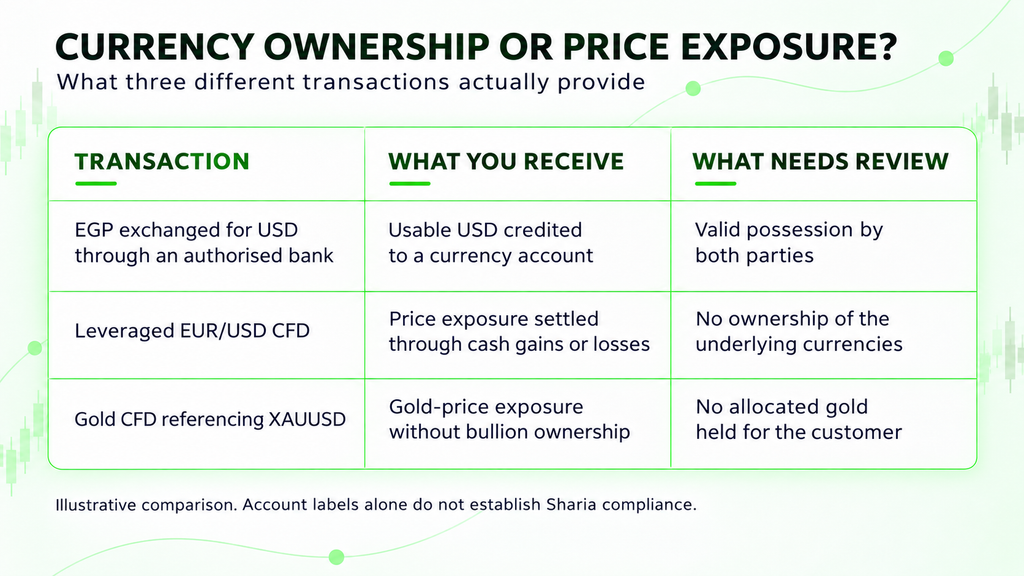
An Egyptian freelancer is paid in dollars. Some of that money is spent on rent and groceries after being converted into pounds. The remainder is kept in a dollar bank account for overseas trips. Somebody else opens a leveraged EUR/USD position through a platform with the cash difference paid or received when the trade closes. Both are called forex. Only the first involves the acquisition and retention of the currency itself.
So, the question of whether forex trading is halal or haram basically comes down to the contract. Provided the transaction meets the relevant conditions, exchanging currencies can be permissible in Islam. Retail speculation with leverage runs into separate objections, and putting an Islamic account label on a margin account doesn’t make those objections go away.
Five checks organise the points raised by the authorities cited below. They form an editorial framework, not an official Sharia standard:
- Actual ownership and possession of both currencies.
- Immediate exchange without prohibited deferment.
- Freedom from riba, including overnight interest.
- Financing and leverage without prohibited contractual features.
- Clear, lawful terms without prohibited gharar or gambling, through authorised channels.
At Versus Trade, product information helps you see what a trading account actually provides. A broker’s description does not replace an independent Islamic ruling.
Keep your strategy running beyond the trading day with swap-free conditions, including dedicated Islamic account options.
Forex market trading halal or haram: two Egyptian rulings
The ruling by Egypt’s Dar al-Ifta was against the leveraged forex arrangement described in fatwa 3615, dated 17 November 2013. The broker offered leverage for margin trading, a system the ruling determined had issues with its contracts, too much uncertainty, and harm. For an Egyptian Muslim trader weighing online speculation, that decision carries real weight.
A separate ruling dated 3 August 2025, number 8732, permits electronic currency exchange through licensed channels when both parties receive their countervalues immediately upon completing the contract. An agreed delay of several days is rejected.
Those two decisions address different arrangements. The later one does not declare that leveraged forex trading is halal, nor does it approve retail derivatives. It recognises properly executed electronic exchange.
Currency exchange serves everyday economic needs, from paying overseas suppliers to transferring savings between currencies. Economist Simon Potter described its role in a speech.
Vice Chair FIC Millennium—Simon Potter, FX Week Conference speech, 14 July 2015
What AAOIFI says about the forex market
AAOIFI Standard No. 1 allows currency trading subject to conditions, including possession by both parties before separation, equal amounts when exchanging the same currency, and no contractual deferment of delivery. These rules do not automatically approve forex trading platforms. From an Islamic viewpoint on the foreign exchange market, the contract remains important. Saying forex is halal leaves out whether someone receives currency or simply gains exposure to its price. The same is true of saying that all foreign exchange trading is haram in Islam.
For forex transactions, the decisive evidence may sit in a clause buried several pages into the agreement. A dollar balance can serve as the account’s reporting unit without representing dollars purchased in a particular trade. The currency symbol cannot establish the rights attached to the position. And that distinction matters even when the displayed price closely tracks an exchange rate.
A relative-performance product adds another layer. Pairs trading expresses a view on one asset against another through a derivative. Such trading activities need their own assessment. A market comparison does not establish ownership or halal trading by itself.
Online trading and Islam: five contract checks
1. Possession: currency received or a number on screen
Qabd means possession. Islamic finance recognises possession without physical delivery. This includes account credits that meet the relevant conditions. But the money you see on a platform might just be collateral or an amount owed when a trade closes. This does not imply that the client possesses the currency.
The distinction shows up clearly across three different situations:
A receipt that proves something
The record should show which currencies were exchanged, the agreed exchange rate, and when the trade was done. It should also show when the buyer could use the purchased currency. Trading involves a different legal relationship if withdrawals return collateral and cash profit or loss, without delivery of the purchased currency. Jordan’s Iftaa Department analysis distinguishes receiving the purchased currency from receiving its value in dollars. It rejects the Islamic Forex accounts because they retain margin trading and lack valid possession.
2. Settlement: immediate exchange, not merely fast execution
Spot trading with immediate possession can meet a central condition of sarf, the exchange of money. But a quick order confirmation does not establish settlement. AAOIFI also allows a limited operational transfer delay under customary currency-market practice. The recipient cannot dispose of the currency until the transfer takes effect. That differs from agreeing to a deferred exchange. An industry settlement convention alone does not establish compliance.
The International Islamic Fiqh Academy’s currency resolution prohibits deferred currency sales. The legitimacy of forex trading depends on the transaction. The term ‘spot trading’ does not make it halal.
3. Riba in forex trading: swaps and financing
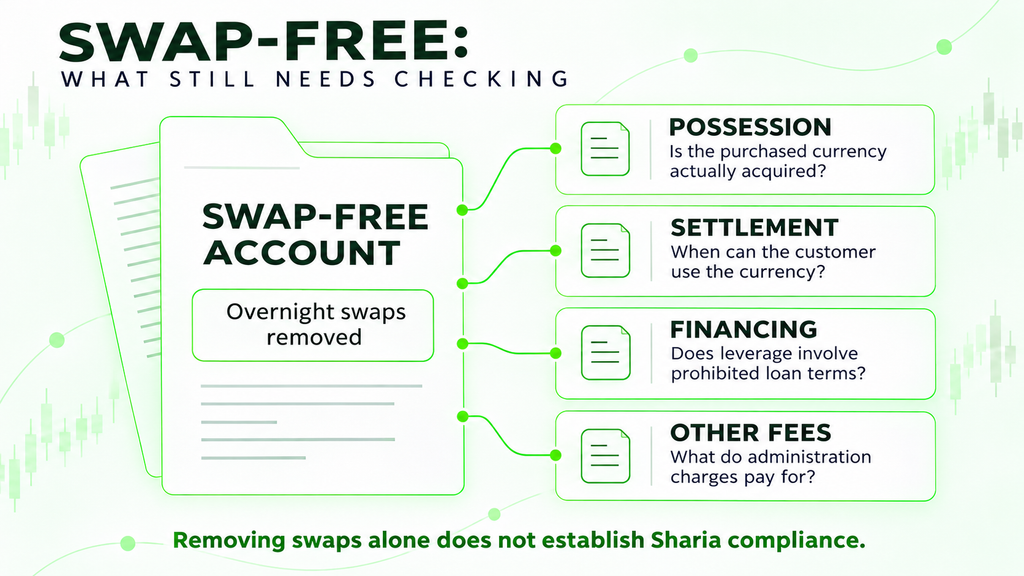
Riba may come from interest in forex trading or when a position rolls over. A swap-free account removes the swap charge. The remaining trading terms still require review, including any administration charge: what it pays for, how it is calculated, and whether a service is actually supplied.
An Islamic trading account may let clients trade without overnight swaps while retaining a contract that raises other objections. A halal forex trading account requires more than a renamed fee. The same applies to a product advertised as an Islamic forex account.
4. Leverage: a larger position always has a contract behind it
Margin trading lets a $100 deposit support a $10,000 position at 1:100 leverage. Loses before costs are 1% of the position’s value. The broker may close it before these losses reach that point.
Leverage in forex can cause issues. A broker may profit from a loan-linked arrangement, while some products give the customer no ownership of the currency. Some derivatives structure leverage without a formal cash loan, so the documents have to be checked case by case. Lowering the leverage ratio will not repair a defective exchange.
For a primer on currency pairs and price moves, see what is forex trading. Deciding whether trading is halal or haram requires examining the contract, beyond those mechanics.
5. Gharar, maysir and lawful access in halal forex trading
In forex trading, gharar concerns prohibited uncertainty in the deal itself. The movement of a price up or down is not, by itself, gharar. Maysir means gambling. Even when prices are clear and trading strategies are disciplined, a contract can still contain prohibited terms.
Halal forex trading practices also depend on lawful access. Egypt’s 2025 ruling requires the use of licensed channels and compliance with local regulations. A foreign license alone does not prove that a provider is authorised to serve Egyptian customers.
Islamic forex trading: account labels and trading practices
Search results for Islamic forex accounts or swap-free arrangements often focus on overnight charges. Descriptions of forex accounts or swap-free accounts can skip possession, financing, and settlement. An Islamic forex account label alone does not answer those questions.
Versus Trade’s LinkedIn article, “Which Instruments Does Versus Trade Offer?”, lists its CFD instruments and swap-free coverage for selected products. That is product information, not a scholar’s finding that those instruments are available for halal forex trading.
Vitalii Bulynin talks about trading behaviour in a published LinkedIn post:
CEO and co-founder of Versus Trade—Vitalii Bulynin
That point addresses risk management alone. It does not prove Sharia-compliant trading. A forex broker’s trading practices and an Islamic scholar’s assessment answer different questions.
Request the instrument specification, settlement terms, and swap-free conditions from the Versus Trade team for independent review.
Try strategies, explore MT5 and get a feel for the markets with a demo account before putting real capital on the line.

Day trading and Islamic finance
Closing before rollover bypasses one overnight event. It does not create missing ownership or remove a prohibited financing arrangement. Saying that day trading is considered halal just because positions close fast mixes up timing and contract structure.
The label “day trading halal” skips the contract. The authorities cited here say trading becomes haram when forbidden contract features stay in place. Holding for a few hours does not fix what is haram in forex trading.
Forex and CFD contracts: gold needs a separate review
An Egyptian family buying bullion and a trader opening XAUUSD may both watch gold prices. Only one of them may actually take delivery of metal. The AAOIFI’s gold standard requires possession, including allocation for constructive ownership. Gold trades settled purely by price differences do not create that ownership.
If you intend to trade gold, the fact that gold itself is acceptable does not make every instrument halal for Muslims. A halal way to own gold and a leveraged gold derivative have different contract features.
The Forex CFD category works the same way: it gives currency-price exposure. CFDs do not deliver the underlying currencies. Swap-free status by itself does not show halal forex trading.
A document pack for an Egyptian scholar of Islam
An approach to forex trading based on evidence gives a reviewer more than a marketing page:
- The legal entity, client agreement, and evidence of applicable authorisation.
- The instrument specification and ownership or delivery rights.
- The financing structure, full fee schedule, and any swap-free account exceptions.
- A sample transaction showing settlement and withdrawal rights.
- Any claimed Sharia certificate, its issuer, date, and precise scope.
These papers allow a scholar to judge whether the specific trading arrangement is permissible in Islam. A marketing label cannot make trading permissible in Islam. Money from forex trading has to be assessed against the transaction that produced it. Past transactions may need individual guidance.
When is forex halal: what the Islamic ruling depends on
Currency exchange can be considered halal when the relevant Sharia conditions and lawful-channel rules are met. That is the qualified sense in which forex trading can be halal. It does not mean every retail forex product is allowed.
Muslims can participate in forex that meets those conditions. Permission to participate in forex trading does not imply the allowance of leveraged derivatives. Islamic trading without swaps raises further questions about the contract. Any claim that trading can be halal must be supported by documents.
Before you start trading, contact Versus Trade for written product details to share with a qualified adviser.
Risk disclaimer: Forex and CFDs carry high risk. Leverage can magnify losses quickly, and capital is at risk. This article is educational information, not investment advice or a fatwa. Product availability and legal permissions differ by jurisdiction. A qualified Islamic scholar should examine the actual contract and account terms.
- Forex market trading halal or haram: two Egyptian rulings
- Online trading and Islam: five contract checks
- 5. Gharar, maysir and lawful access in halal forex trading
- Islamic forex trading: account labels and trading practices
- Forex and CFD contracts: gold needs a separate review
- A document pack for an Egyptian scholar of Islam
- When is forex halal: what the Islamic ruling depends on