
What Is Swing Trading? Guide to Medium-Term Market Speculation

- How Does Swing Trading Work?
- Is Swing Trading Suitable for Beginners?
- What Tools and Indicators Are Used in Swing Trading?
- Risk Management for a Swing Trader
- Is Swing Trading Profitable?
- Pros and Cons of Swing Trading
- Swing Trading in Indonesia: Regulation and Market Realities
- Summary Checklist for New Swing Traders
Swing trading is an active trading approach in which positions are held for several days or weeks to capture part of an expected upward or downward price move. Put simply, the question “what is swing trading?” comes down to position duration and selective exposure to market movement. This method sits between intraday trading and longer-term position trading in terms of its typical holding period. While the slower pace reduces the need for constant monitoring compared to short-term scalping, overnight exposure and leverage introduce risks that require structured management, robust money management rules, and careful monitoring of every open position.
How Does Swing Trading Work?
The mechanics of swing trading rely on identifying intermediate market waves rather than focusing on minute-by-minute fluctuations. Participants establish a position in a chosen financial asset based on technical or fundamental analysis, aiming for a favorable risk-to-reward ratio over a multi-day timeframe. Market access also depends on factors that do not appear directly on a chart. Across Southeast Asia, traders may assess a provider through its local reputation, reliability, and relationships within the financial community.
Regional Director Thailand & Laos, Versus Trade — Janis Baltalksnis
Whether trading global equities, energy commodities, or exploring CFD trading, understanding these mechanical steps keeps expectations grounded in risk control rather than guaranteed outcomes.
Financial markets rely on various volume metrics to gauge activity. In decentralized forex and CFD markets, tick volume counts price changes rather than the number of contracts traded. It can provide a partial indication of market activity, but it does not reveal actual transaction volume or distinguish between institutional and retail participation.
Swing Trade vs. Day Trading
Choosing a trading style depends on your schedule, capital goals, and risk tolerance. The structural differences between swing trading and day trading shape how positions are monitored and managed:
| Feature | Swing Trading | Day Trading |
| Timeframe | Days to several weeks | Minutes to hours |
| Overnight Exposure | Positions are held overnight, introducing weekend and gap risks | No overnight exposure; all positions are closed before the session ends |
| Typical Monitoring Frequency | Periodic checks throughout the day or once daily | Continuous real-time monitoring during active market hours |
| Transaction Frequency | Lower frequency, reducing overall execution overhead | Higher frequency, resulting in numerous trades per session |
| Financing Costs | Potential swap or overnight financing fees for leveraged products | Generally no overnight financing fees |
How Swing High Swing Low Structure Shapes a Setup
Market prices move in cyclical waves rather than straight lines. Identifying these turning points allows traders to structure entries with defined risk parameters.
- Higher Highs and Higher Lows: In an upward trend, the market prints successive peaks and troughs, establishing a structural rhythm where pullbacks toward previous support levels may create potential short-term trading opportunities if the broader structure remains intact.
- Lower Highs and Lower Lows: In a downward trend, failing rallies create lower peaks, allowing short-position setups as momentum resumes downward.
Keep your strategy running beyond the trading day with swap-free conditions, including dedicated Islamic account options.

Is Swing Trading Suitable for Beginners?
Swing trading is frequently discussed as an option for newcomers because the slower pace allows adequate time for thoughtful analysis, risk calculation, and decision-making. However, it is not inherently simple or risk-free. Practical limitations for beginners include dealing with overnight gaps, floating losses, margin requirements, and the temptation to use excessive leverage. A less demanding monitoring schedule does not make position sizing or emotional discipline automatic, and educational material provided by brokers should always be verified against real market conditions.
What Tools and Indicators Are Used in Swing Trading?
Equipping a workspace properly helps filter out market noise and identify potential inflection points without requiring intraday tick data. A well-organized trading room or digital dashboard typically incorporates multiple technical analysis tools to evaluate market swings, identify entry signals, and manage the exit process effectively.
| Analysis Tool | Primary Function | Best Used For |
| Moving Averages (SMA / EMA) | Smooths out random price data to show trend direction | Spotting overarching market bias and dynamic support or resistance |
| Relative Strength Index (RSI) | Measures the speed and magnitude of recent price changes | Identifying overbought or oversold extremes and momentum divergences |
| Volume Profile | Shows where recorded or available trading activity was concentrated by price | Identifying high-volume nodes that may serve as reference areas |
| Average True Range (ATR) | Measures absolute price volatility over a given period | Setting objective stop-loss distances and calibrating position sizes |
| Support and Resistance Zones | Identifies historical price levels where buying or selling pressure concentrated | Locating structural invalidation and target points |
Swing Trading Strategies for Forex and Other Markets
Trend Pullback
Traders identify an established trend in forex, stocks, or commodities using moving averages and wait for a retracement toward a key structural support or moving average before entering in the direction of the primary momentum. Where reliable volume data is available, traders may also examine whether activity contracts during the pullback and expands when the primary trend resumes.
Breakout and Re-test
This strategy focuses on key structural boundaries. Traders wait for a price break past a resistance or support level, followed by a retest of that former barrier acting in its new structural role before entering. Where reliable exchange or broker volume data is available, traders may also examine whether activity expands during the breakout.
Range-Bound Mean Reversion
When an asset moves sideways within a horizontal channel, traders look for the instrument’s price to oscillate between established support and resistance extremes, capitalizing on cyclical sentiment shifts.
Finding a Profitable Setup With Channels and Momentum
To build a methodical trading routine, market participants can follow a structured sequence from analysis to execution:
- Identify the dominant trend on a higher timeframe (such as the daily or 4-hour chart) using moving averages.
- Locate an orderly price channel or boundary where momentum shows signs of slowing.
- Wait for a controlled pullback toward the channel support or a key moving average.
- Check momentum indicators like the RSI or MACD for confirmation or divergence.
- Calculate the distance to your protective stop-loss using structural levels or ATR.
- Determine your position size based on your account risk parameters.
- Execute the trade and log the setup in a trading journal.
As legendary trader Larry Hite explained in The New Market Wizards, a speculator’s primary advantage is selectivity:
Hedge fund manager — Larry Hite, Market Wizards: Interviews with Top Traders
(Jack D. Schwager, New York: New York Institute of Finance, 1989.)
For a swing trader, that advantage appears as discipline: a chart does not require a trade until price, momentum, and risk align. You can test these analytical setups in a simulated environment using a demo trading account before committing real capital.
Risk Management for a Swing Trader
Capital preservation precedes profit generation. Effective risk management addresses stop-loss placement, gap risks, overnight financing fees, and the correlation between open positions across a portfolio. Consistent money management can limit the effect of adverse price movements, although gaps and slippage may still produce losses beyond the planned amount.
Risk profiles vary across swing trading strategies, so stop placement and position size should reflect the structure and volatility of each setup.
What Is the 2% Rule in Swing Trading?
The 2% rule is a widely referenced risk management guideline suggesting that a trader should risk no more than 2% of their total account equity on any single trade setup. The stop-loss distance is determined by market structure or volatility, while the 2% risk limit is used to calculate the maximum position size.
Account balance: IDR 20,000,000 Maximum planned risk: IDR 400,000 Risk per share: IDR 200 Maximum position size: 2,000 shares
If the order is filled at the planned stop price, the loss would be approximately IDR 400,000 before fees. A price gap or slippage could produce a larger loss.
For deeper professional perspectives on modern trading dynamics, review this team discussion: What We Didn’t Have Time to Say at FMSS 2026.
Build and test a structured swing trading plan with Versus Trade tools before moving to live execution.
Is Swing Trading Profitable?
Profitability in swing trading relies heavily on whether your method maintains a repeatable statistical edge after all trading costs are factored in, backed by disciplined risk management, steady execution, and broader market conditions. Long-term results are governed by mathematical expectancy based on win rate, average win size, average loss size, and execution costs.
Expectancy can be evaluated through the following formula:
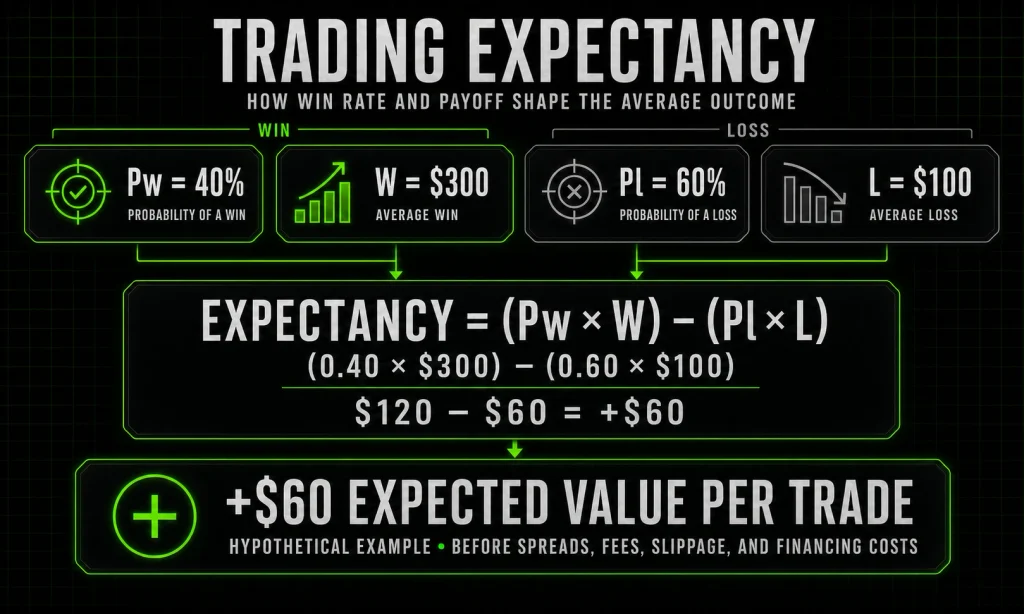
Where Pw represents the probability of a win and W is the average profit on a winning trade, while Pl stands for the probability of a loss and L marks the average amount lost on a losing trade. For instance, if your trading strategy features a 40% win rate ($P_w = 0.40$) alongside an average win of $300 ($W = 300$) and a 60% loss rate ($P_l = 0.60$) with an average loss of $100 ($L = 100$), you calculate the expectancy like this:
Expectancy=(0.40×300)−(0.60×100)=120−60=60
Under these hypothetical assumptions, the strategy yields an expected average gain of $60 per trade before factoring in spreads, fees, slippage, and financing costs. Actual results can vary if your estimated win rate or average outcomes fail to hold up over time. Systematic participants who manage their downside effectively aim for a positive expectancy over a series of trades, acknowledging that individual setups frequently fail and past performance does not guarantee future outcomes.
Pros and Cons of Swing Trading
| Pros of Swing Trading | Cons of Swing Trading |
| Reduced Screen Time: Requires significantly less monitoring than day trading, preserving time for other daily commitments. | Overnight Exposure: Vulnerable to weekend gaps, macroeconomic data drops, and geopolitical shifts while offline. |
| Potential to Capture Larger Moves: Captures broader structural trends rather than razor-thin intraday scalps. | Holding Costs: Swap or overnight financing fees may accumulate while leveraged positions remain open. |
| Less Continuous Monitoring: Mitigates the high-frequency panic and emotional fatigue common in fast-paced session trading. | Opportunity Cost: Part of the account’s available margin remains committed while positions are open, meaning traders may miss rapid momentum bursts elsewhere. |
Beyond the metrics of the table, swing trading fosters patience and a macro-oriented analytical mindset, though it requires the mental fortitude to manage open risk while away from the market and during periods of reduced liquidity.
Swing Trading in Indonesia: Regulation and Market Realities
Operating from Indonesia requires awareness of the regulatory bodies overseeing different financial instruments. OJK oversees Indonesia’s capital markets and, since the January 2025 transfer of authority, digital financial assets, including crypto assets. Bappebti continues to regulate commodity futures trading and related commodity-market activities. The applicable regulator therefore depends on the instrument and trading venue. International leveraged CFD providers may hold licences in overseas jurisdictions. An overseas licence does not necessarily mean that the provider is authorised in Indonesia or that an Indonesian client receives local regulatory protection.
When trading from Indonesia, local market participants must account for the opening hours of overseas markets and convert them to the relevant local time zone, whether WIB, WITA, or WIT. The local equivalent may shift when the overseas market enters or leaves daylight saving time.
Is Swing Trading Halal?
Whether a swing-trading arrangement is truly Sharia-compliant depends entirely on the specific instrument, contract structure, financing terms, and underlying asset you choose. Opting for a swap-free or Islamic account may eliminate conventional interest-based rollovers, although separate administrative or holding charges can still apply.
Traders seeking Sharia compliance should review the complete product and fee structure and, where necessary, consult a qualified Sharia adviser.
Summary Checklist for New Swing Traders
- Master Market Structure: Understand the fundamental mechanics of multi-day trend analysis, identifying clear swing highs and lows rather than guessing tops and bottoms.
- Enforce Strict Risk Parameters: Guard your account by maintaining tight risk controls—such as the 2% guideline—and setting protective stop-losses past logical structural breaking points.
- Validate via Simulation: Trial your trading ideas in a secure demo environment to evaluate your execution and emotional discipline before trading with real funds.
- Verify Regulatory and Account Terms: Make sure your chosen brokers, assets, and account setups meet all local standards and fit your specific trading needs.
Stepping up from an observational spectator into a disciplined trader requires steady focus, careful data evaluations, and unyielding loyalty to your blueprint. Take control of your financial journey and start trading with professional precision today.
Markets move fast. Get the flexibility to adjust your exposure and trade opportunities your way with leverage up to 1:2000.

- How Does Swing Trading Work?
- Is Swing Trading Suitable for Beginners?
- What Tools and Indicators Are Used in Swing Trading?
- Risk Management for a Swing Trader
- Is Swing Trading Profitable?
- Pros and Cons of Swing Trading
- Swing Trading in Indonesia: Regulation and Market Realities
- Summary Checklist for New Swing Traders