
What is Options Trading: A Complete Beginner’s Guide


- Options Trading Explained: How Contracts Actually Work
- Call Option vs. Put Option: The Two Pillars of Options Trading
- Real-World Options Trading Example: Step-by-Step Scenario
- Options vs. Stocks: Key Differences Every Trader Must Know
- Practical Questions: Account Capital & Daily Expectations
- Popular Trading Strategies for Beginners
- How Options Pricing and Risks Work
- Options Trading Regulation in Thailand: Legal Framework & Local Rules
- Final Checklist: Getting Started Safely in Financial Markets
An options contract is a flexible financial derivative that gives the holder the right, but not the obligation, to buy or sell an underlying asset at a specified price. Trading options allows investors to speculate on directional price moves, generate recurring income, or hedge portfolio risk with defined leverage, making it a powerful alternative to direct stock ownership.
CEO, Versus Trade — Vitalii Bulynin
Markets today don’t look like they did twenty years ago. Across Thailand and Southeast Asia, retail volume has blown up. A whole new wave of retail participants wants direct control, speed, and real strategic flexibility. Direct stock ownership leaves the investor exposed to price declines for as long as the position remains open. But learning how to trade options gives you ways to maneuver around price swings. You can bet on sharp directional moves, run a portfolio hedge, or build structured plays for beginners without tying up all your capital.
Options Trading Explained: How Contracts Actually Work
If you want to grasp what is options trading, you have to pull back the hood on how these contracts settle on the exchange. Strip away the jargon, and an option is a contract—a clear agreement between two sides tied directly to a stock, index, or future market.
Whether you are buying options or selling contracts, every deal comes down to a few set terms. Because options mechanics feel confusing at first, smart traders test their execution on a demo trading account long before risking real cash on active order books.
The 4 Core Structural Parameters
- Underlying Asset: The actual asset driving the contract value—usually single stocks, ETFs, commodities, or major market indices.
- Strike Price: The specific price where the contract holder can trigger their right to buy or sell the underlying paper.
- Expiration Date: The cutoff day when the setup reaches its formal expiration. At expiration, an out-of-the-money option normally expires worthless. An in-the-money option may be exercised under the broker’s and clearinghouse’s expiration procedures or settled in cash, depending on the contract.
- Options Premium: The hard cash paid for the option by the buyer to the seller.
Contract Sizing and Pricing Mechanics
When you step in to trade options, standardized contract sizing dictates your position size. In the US market, a standard equity option typically represents 100 shares, although contract multipliers can differ by product and may change after certain corporate actions.
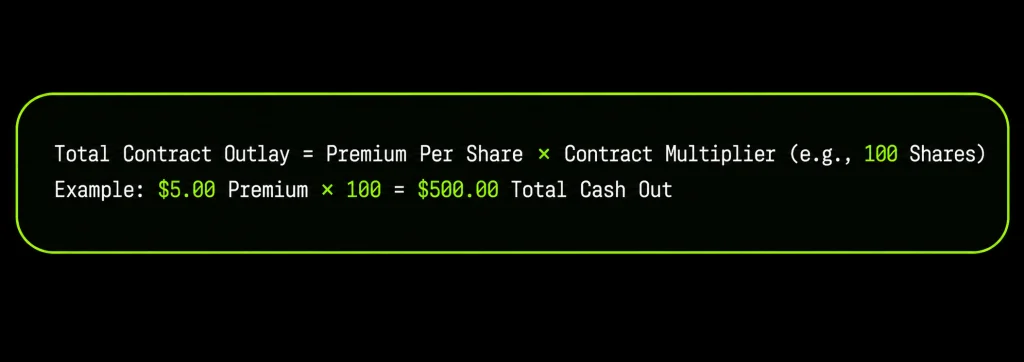
When a quote board shows an options premium of $5 per share, the actual cash cost to buy that standard contract is $500. That structure gives you control over a substantial asset at a set price without needing the heavy cash stack required to buy and sell physical shares on the spot market.
Time Decay and Value Dynamics
An option’s premium breaks down into two parts: its real baseline worth (intrinsic value) and external factors like time and market sentiment. That second part reacts to how much time is left before expiration, implied volatility, expected dividends, and overall market demand. As the calendar ticks down, time decay continuously chips away at this extra value, though sharp price swings can temporarily pause the drop.
Go from registration to trading with Versus Trade in 5 minutes.

Call Option vs. Put Option: The Two Pillars of Options Trading
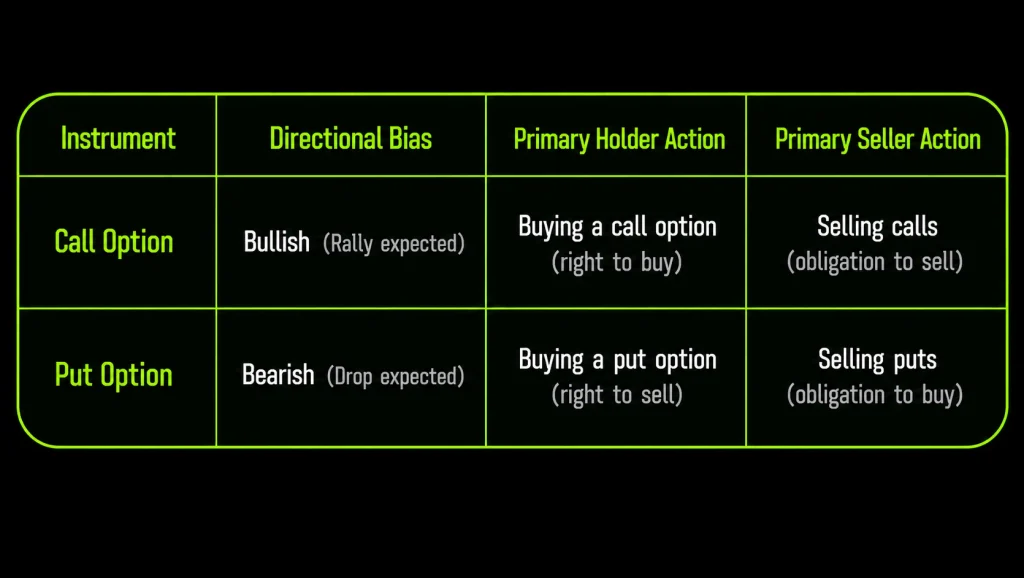
Every single option setup relies on two core building blocks: calls and puts. You need these types of options down cold before opening an order window.
How a Call Option Works (Bullish Bets)
A call option gives the buyer the right to buy a stock or other underlying asset at a preset strike price, either before expiration or only at expiration, depending on the option’s exercise style. Traders jump on buying call options when they expect underlying price movements to push the asset higher than the strike price.
If the stock rises sufficiently, the holder may exercise the contract to buy the shares below the current market price or sell the option itself for a profit. If the stock falls flat, you just walk away. Your loss stops cold at the initial premium paid.
How a Put Option Works (Bearish Protection & Speculation)
A put option flips the dynamic. It gives the holder the right to sell a stock or asset at a fixed strike level. Traders buy a put option to speculate on market drops or protect an equity bag against sudden downside risk.
When paired with a corresponding stock position, a put can establish a minimum exit price for those shares. When purchased on its own, the put limits the buyer’s loss to the premium paid. If the asset price drops lower than the strike price, the put contract shoots up in value, allowing holders to execute their right to sell an underlying asset or sell the contract back to the market.
Real-World Options Trading Example: Step-by-Step Scenario
Let’s ground the basics of options trading in a realistic market play using a tech stock, ticker $ PEAR, sitting at $145.
Step 1: Setting Up the Trade
You’ve analyzed PEAR stock ahead of earnings and expect a solid beat. Instead of dropping $14,500 on 100 physical shares, you use options to keep your total risk capped.
- Asset: PEAR Stock ($145 current price)
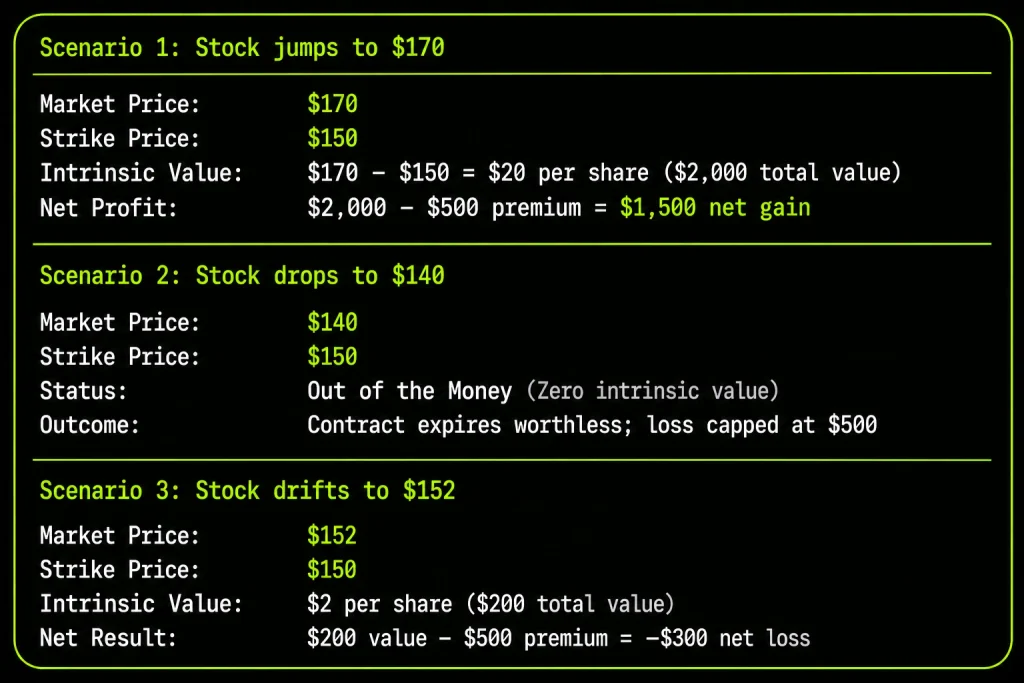
- Contract Pick: Call option with a strike price of $150 expiring in 30 days.
- Quoted Premium: $5 per share.
- Cash Required: $5 × 100 shares = $500 total outlay.
Step 2: The Three Earnings Outcomes
30 days pass, the earnings numbers hit the tape, and the stock moves. Here is how your options contract handles three different scenarios:
Master your entries, exits, and position sizing risk-free on a demo trading setup before stepping onto live order books.
Understanding Moneyness: ITM, OTM, and ATM
Traders break option pricing down into three states of moneyness:
- In the Money (ITM): The contract holds real, actionable worth because the stock price has crossed your strike level. In this state, the option has intrinsic value you could realize immediately.
- Out of the Money (OTM): The price hasn’t reached your strike yet, so the option has zero intrinsic value. Its price relies entirely on time left and market expectations.
- At the Money (ATM): The market price of the underlying asset matches the strike price down to the penny.
Options vs. Stocks: Key Differences Every Trader Must Know
Deciding whether to buy spot equity or trade derivative setups comes down to your risk limits, capital size, and time horizon.
The founder, Empirica Capital LLC — Nassim Nicholas Taleb
“Fooled by Randomness: The Hidden Role of Chance in Life and in the Markets.” (2001)
When you buy and hold the underlying equity, you own an actual slice of the company. Options provide contractual rights or obligations without necessarily conveying ownership of the underlying shares.
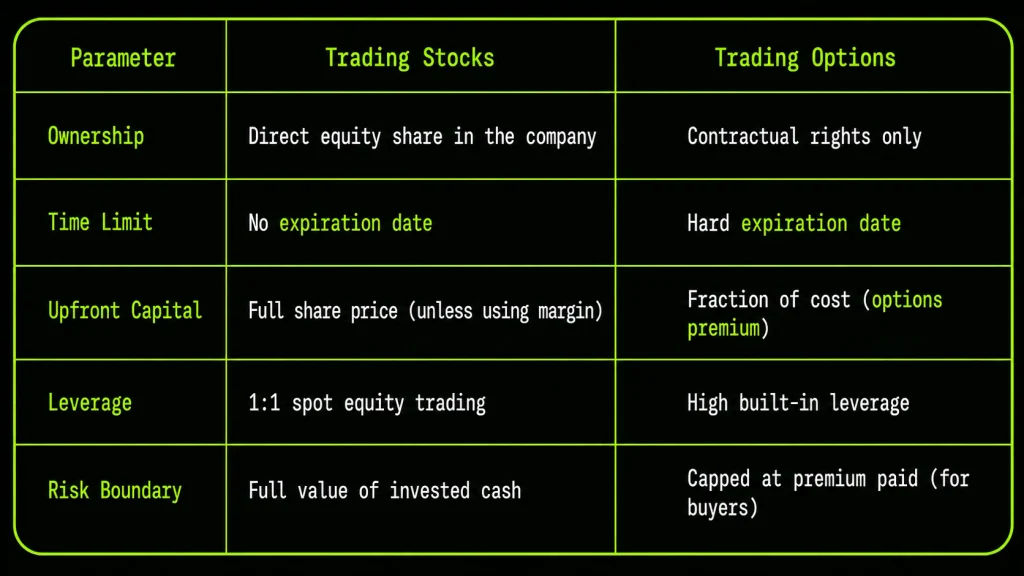
Because options let you control big positions with relatively small outlays, the inherent leverage is massive. But that leverage cuts both ways. If your market timing is off, an option trading position bleeds fast. Option buyers risk watching their entire investment go to zero if the trade ends up out of the money at the bell.
Understanding how market structures evolve across global financial hubs is critical for modern careers. Check out our breakdown on hiring trends in The Real Reason You’re Not Getting Hired in Fintech.
Practical Questions: Account Capital & Daily Expectations
Can you trade options with $100?
Yes, you can start trading options with $100, but your choices will be limited by pricing structures and account type constraints. Since standard equity contracts represent 100 shares, a $100 budget means you can only buy options with a premium of $1.00 per share or lower ($1.00 × 100 = $100).
- Out-of-the-Money Contracts: With $100, you will mostly be looking at cheap, out-of-the-money calls or puts, or options on lower-priced stocks. While accessible, cheap contracts carry a higher probability that the option expires completely worthless before reaching profitability.
- Defined-Risk Spreads: If the broker approves multi-leg trading, some small accounts may use narrowly structured debit or credit spreads. These option strategies combine long and short contracts that give the holder rights while placing obligations on the seller. When structured correctly, the spread can cap the maximum loss, although the required net premium or collateral depends on the strike width, option prices, fees, and broker rules. Only some spreads can be opened with less than $100.
- Capital Preservation: While $100 is enough to practice live order execution, managing risk is tough with small balances. Position sizing rules suggest never risking your entire account balance on a single trade.
Can you make $1000 a day trading options?
Making $1,000 a day trading options is theoretically possible, but it requires significant capital, advanced strategy execution, and strict risk discipline. It is not realistic for a beginner starting with a small account.
- Capital Requirements: There is no standard account size that can reliably produce $1,000 per day. The capital required depends on the strategy, risk taken, market conditions, trading costs, and broker requirements, while no account size guarantees consistent daily profits. Expecting a $1,000 daily return on a $2,000 account would require extreme risk-taking and creates a high likelihood of rapid, substantial losses, including the possible loss of the entire account.
- Professional Selling Strategies: Institutional traders and income-focused professionals often sell options contracts (such as selling covered calls or cash-secured puts) to capture time decay. These strategies demand higher capital reserves to cover margin requirements or underlying share assignments.
- Understanding Risks: Higher return targets mean taking on magnified exposure. The structural risks of options mean that aggressive trading can lead to swift drawdowns if the market shifts against your position. Consistent daily profitability demands an established edge, disciplined stop losses, and deep risk management rather than speculative gambling.
Popular Trading Strategies for Beginners
Retail traders use focused options trading strategies to build structured trades regardless of market conditions across different types of options.
- Protective Put (Portfolio Insurance): An investor holding physical shares buys a put to hedge market drops. If the stock crashes, gains on the put absorb the damage on the physical stock bag.
- Covered Calls (Income Generation): An investor holding 100 shares sells calls against their position to generate income off the collected premiums.
- Long Straddle (Volatility Setup): A trader buys both a call and a put option with the same strike price and expiry. The strategy can become profitable if the underlying moves far enough in either direction to exceed the combined premiums paid and trading costs.
Execution Styles: European vs. American Options
Contract terms dictate exactly when you can exercise your position:
American-style options may generally be exercised on any business day through expiration, subject to the broker’s exercise instructions and cutoff times. European-style options may be exercised only at expiration.
How Options Pricing and Risks Work
The market price of the options on the order book shifts constantly based on bid-ask flow, asset trends, trading volumes, and broader market volatility.
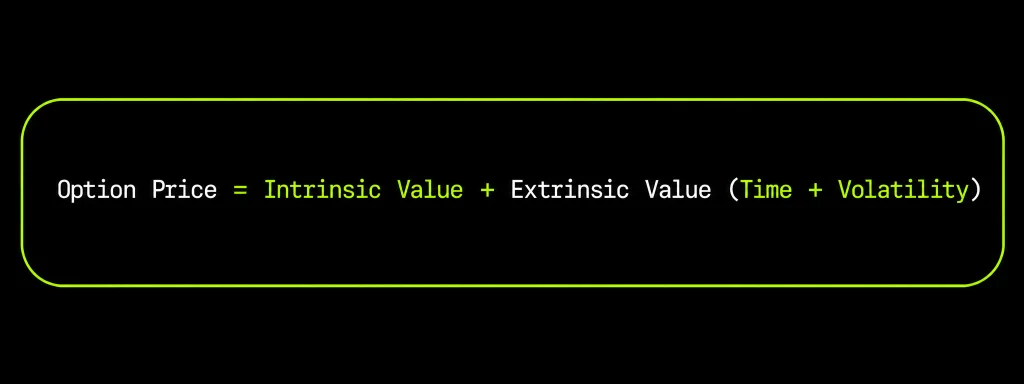
When market uncertainty spikes, option premiums blow out because everyone wants portfolio protection. After a major event or a decline in uncertainty, implied volatility can fall sharply in what traders call a volatility crush. This can reduce an option’s extrinsic value, although the option’s total price may still rise or fall depending on the underlying asset’s movement and other factors.
Risk Controls and Market Caveats
Before trading real money, you have to be completely clear on how options can bite you:
- Time Decay Pressure: Options are decaying assets. The closer you get to expiration, the faster the remaining time value evaporates.
- Uncovered Exposure: Buying options limits your worst-case scenario to the premium paid. But if you sell options naked, you’re taking on unlimited risk if the asset moves violently the wrong way.
- Liquidity Spreads: Slippage is a silent killer in quiet markets. Low contract volume creates wide spreads, forcing you to give up edge just to get filled.
Regulatory Caution: Binary Options
Regulators across the UK, EU, and Australia have effectively banned or heavily restricted retail binary options, treating them more like high-risk gambling than trading. Rules are different in the United States, where binary options can be legally traded, but only through strictly regulated designated exchanges.
Platform Capabilities & Educational Scope
Let’s keep expectations clear. Versus Trade is a CFD trading platform and Forex broker. Versus Trade does not offer exchange-traded options contracts as a tradable asset. This guide exists purely as educational material to help traders understand market derivatives, risk structures, and global financial mechanics.
Options Trading Regulation in Thailand: Legal Framework & Local Rules
If you are trading from Thailand, navigating local financial laws and oversight bodies is critical before executing derivative trades. The legal landscape for financial derivatives in Thailand is strictly structured to balance market access with consumer protection.
The Regulatory Framework: SEC Thailand & TFEX
Exchange-traded derivatives and licensed derivatives intermediaries in Thailand are primarily regulated by the Thai SEC under the Derivatives Act B.E. 2546 (2003). Depending on the product and transaction, Bank of Thailand rules, including foreign-exchange regulations, may also apply.
- Domestic On-Exchange Trading (TFEX): Local retail and institutional participants can legally trade standardized index options (such as the SET50 Index Options) directly on the Thailand Futures Exchange (TFEX), a licensed subsidiary of the Stock Exchange of Thailand (SET). TFEX members operate under local regulatory and exchange requirements. Some eligible clients trading through members of the Derivatives Investor Protection Fund may receive limited compensation in specified circumstances, such as a member’s insolvency.
- Offshore Brokers & Global Market Access: Just because an offshore broker holds a license abroad doesn’t mean they’re registered or supervised by the Thai SEC. If you trade with them, local Thai investor protection rules won’t cover your account.
- Taxation on Foreign Income: Starting with foreign income earned from January 1, 2024, Thai tax residents may owe Personal Income Tax (PIT) on trading profits brought into Thailand. If you bring that foreign-earned cash into the country—whether in the same year or later—it can trigger a local tax liability. The treatment depends on tax residency, the nature of the gain, available exemptions, and any applicable tax treaty or foreign tax credit.
Oversight and Capital Mechanics
The regulatory stance on binary options and risk requirements includes specific parameters:
- Binary Options Oversight: Binary options are not supervised by the Thai SEC in the same way as regulated exchange-traded options. The SEC has warned investors about online and offshore providers, particularly where the operator is not licensed in its home jurisdiction.
- Margin Requirements: Positions on the TFEX require margin deposits to back your derivatives exposure and reduce systemic risk. Keep in mind, these requirements are purely for credit backing—they won’t shield you from sharp market drops, sudden margin calls, forced liquidations, or overnight gap risks.
Local Market Insight: If you’re a Thailand-based trader venturing into global markets, your top priorities should be clear broker transparency, reliable fund protection, and full compliance with local tax regulations when trading offshore derivatives or CFDs.
Final Checklist: Getting Started Safely in Financial Markets
If you want to stay in the trading game long-term, you need three things: discipline, solid risk rules, and a broker that won’t lag when volatility hits. Here’s what to run through before placing a trade:
- Understand Your Contract: Don’t enter a trade until you know your strike price, contract sizing, and exact time-decay risks inside out.
- Watch Your Position Size: High leverage cuts both ways. Never put more money into a time-sensitive setup than your account can easily afford to lose.
- Paper Trade First: Test your setups in demo accounts to see how trades handle real-time market moves without financial pressure.
- Stick to Trusted Brokers: Trade only with regulated platforms that offer clear fills, reasonable spreads, and stable technology.
At the end of the day, traders who respect risk management and market structure survive – those who trade on pure guesswork don’t last long.
You have the risk checklist – now get the execution to match. Step up your trading approach with transparency and speed on Versus Trade.
Try strategies, explore MT5 and get a feel for the markets with a demo account before putting real capital on the line.

- Options Trading Explained: How Contracts Actually Work
- Call Option vs. Put Option: The Two Pillars of Options Trading
- Real-World Options Trading Example: Step-by-Step Scenario
- Options vs. Stocks: Key Differences Every Trader Must Know
- Practical Questions: Account Capital & Daily Expectations
- Popular Trading Strategies for Beginners
- How Options Pricing and Risks Work
- Options Trading Regulation in Thailand: Legal Framework & Local Rules
- Final Checklist: Getting Started Safely in Financial Markets