
What Is a Cold Wallet and Why Do Long-Term Crypto Holders Use One?


- Why Investors Move Massive Crypto Portfolios Offline
- How a Cold Wallet Works under the Hood
- Real-World Variations: Types of Cold Wallets Available Today
- Hot Wallet vs Cold Wallet: The Crucial Structural Differences
- Strategic Asset Allocation: How an Experienced Broker Manages Risk
- Setting Up Your Cold Storage Wallet Security Without Mistakes
- Deep Evaluation: Pros and Cons of Going Fully Cold
- Conclusion: Balancing Convenience with True Risk Control
What is a cold wallet? Look, stripped down to the basics, a cold wallet is just a physical piece of hardware or an entirely offline storage method that keeps your private key cut off from the web. It doesn’t sit inside a smartphone app or a browser extension that’s always live, which is why this specific form of cold storage greatly reduces exposure to online attacks, malware, and greasy phishing links targeting your digital asset. Think of it like a deadbolted vault: it anchors your blockchain access inside zero-connectivity offline storage. It’s significantly harder to siphon your tokens remotely because they’d have to physically snatch the device out of your drawer and somehow crack your personal identification number (PIN).
It doesn’t matter if you’re just dipping your toes into crypto or looking for a bulletproof setup to hold assets for the next five years. Figuring out how this offline storage setup keeps your money safe is the very first thing you need to check off your list.
- Buy from official sources
Never purchase a hardware wallet from an unauthorized reseller or an unknown marketplace seller. Buy directly from the manufacturer or an officially authorized retailer. There have been documented cases where scammers modified devices or included pre-generated recovery phrases, meaning they can drain your wallet the moment you deposit funds.
2. Initialize on an isolated environment
Plug the physical device into your personal computer. The wallet hardware itself should generate your private key internally using an onboard secure element chip. If the device comes with a pre-printed recovery card, discard it immediately—it’s a scam.
3. Secure your recovery phrase manually
Write down your 12-to-24-word seed phrase on a piece of paper or stamp it into metal. Just keep it off your computer, don’t type it into a web browser, and never put it in a mobile app. No photos either—if that screenshot syncs to Gmail or your cloud notes, you are asking to get cleared out.
Why Investors Move Massive Crypto Portfolios Offline
Leaving your whole balance on an exchange or a standard mobile app is a massive gamble. It is like walking the streets with your life savings stuffed into a back pocket. Fine, use it for quick, regular transactions, but keeping your stack there long-term? You are just waiting to get hit. Online platforms face heavy cyberattacks every single day. The moment an exchange freezes or a security hacker exploits a software wallet vulnerability on your personal computer, your digital asset is gone. Zero warning.
That is precisely why serious traders use a cold storage wallet for the absolute majority of their funds. It turns the security model on its head. Instead of relying on a complex mix of anti-virus software, tricky password settings, and hope, a cold wallet simply removes the bridge to the internet.
A cold wallet for storing digital assets blocks remote entry points entirely. If an online attacker doesn’t have physical access to the device sitting on your desk or tucked inside a safe deposit box, they cannot execute a transaction. It works exactly like a traditional bank savings account—you keep the bulk of your capital locked away safely, only pulling out what you actively need for immediate market moves.
How a Cold Wallet Works under the Hood
Let’s clear up one thing about how cold wallets work: no wallet actually holds physical coins. Your tokens—whether it is Bitcoin, Ethereum, or some micro-cap meme coin—are just data points sitting out there on a decentralized blockchain network. Your device is simply an access panel built to guard your private key.
That private key is essentially your only proof of ownership. It is just a highly complex string of data tied to a specific public address. Thanks to public-key cryptography, anyone can look at the blockchain, see that address, and send you a token. But without the actual private key, nobody can sign transactions to move those assets out. When you initialize a device, it uses open-source software or internal hardware randomness to cook up this key completely offline.
Along with it, it produces a master backup known as a recovery phrase or seed phrase. If your physical device breaks, gets lost, or drops into a cup of coffee, this phrase allows you to restore your entire balance onto a brand-new device. The critical rule is keeping these private keys offline permanently. If you type that seed into a computer text file or an online account, you instantly break the air-gapped protection and expose your funds to the same online threats you bought the wallet to avoid.
The Mechanics of an Offline Crypto Transaction
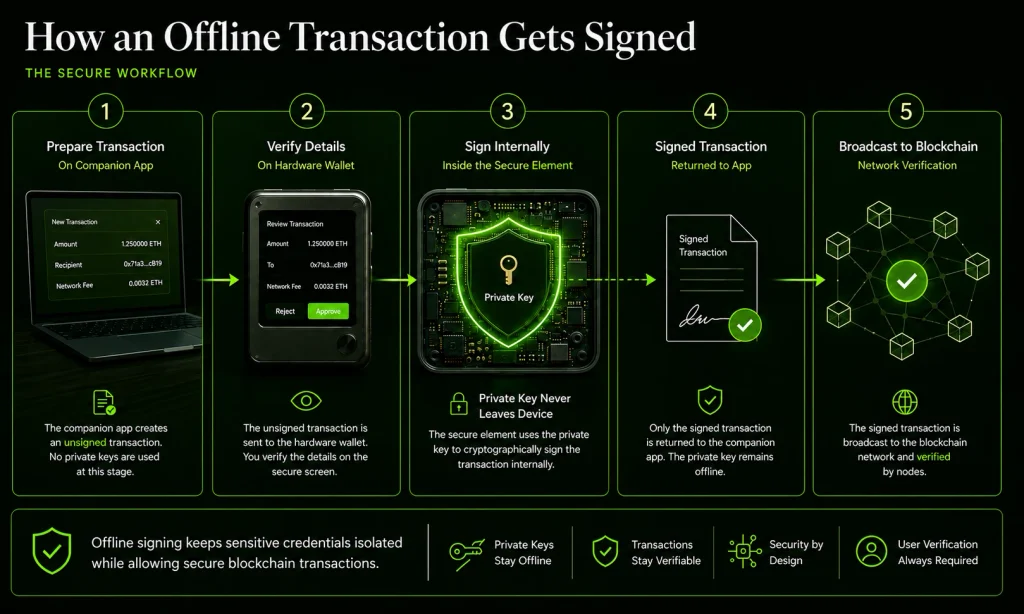
So, how do you use a cold wallet if it never connects to the web? It sounds like a paradox, but the workflow is remarkably elegant.
Let’s look at a clear example. Suppose you want to use your ledger wallet to send some crypto assets to a friend. You don’t open up the device to the internet. Instead, you just use a companion app on your phone or laptop. All this app does is patch together a raw, unsigned transaction—the amount, the destination public address, and the fee. But it can’t broadcast anything because there is no signature on it yet. The app passes this raw data file over to your physical hardware wallet via a USB cable or Bluetooth. From there, the device’s secure element chip takes over, reads the data, and throws the transfer details onto its own tiny screen so you can manually click the physical buttons to approve it.
Once you click confirm, the device uses its internal private keys to sign transactions digitally. The private key never leaves the secure boundaries of the hardware. The device then passes only the finalized, signed signature back to your internet-connected computer hardware, which broadcasts it to the blockchain network. The internet never sees your secrets; it only sees the mathematical proof that you approved the transfer.
Microsoft vs Apple. Bitcoin vs Gold. Nasdaq 100 vs Oil. With Versus Pairs, you decide which side comes out stronger.

Real-World Variations: Types of Cold Wallets Available Today
Not all cold wallets look or feel the same. Depending on your trading routine, budget, and comfort level with technology, different types of cold wallets will fit your strategy. Some focus on heavy physical portability, while others prioritize absolute network isolation.
Hardware Wallet
The hardware wallet is the undisputed gold standard for modern retail traders. These are specialized physical devices engineered from scratch to do exactly one thing: protect cryptographic keys. They run on minimalistic, custom-built operating systems that lack the vulnerabilities found in a massive setup like Windows, Apple iOS, or Android.
The market has a few dominant players. The Ledger Nano series (like the Ledger Nano X or S Plus) and the various Trezor models (including the premium Trezor Model T) have been the industry benchmark for years. Another modern choice is the Tangem wallet, which looks exactly like a traditional bank card and utilizes an NFC chip to sign transactions through a mobile app.
Many hardware wallets pack a secure element—a dedicated, hardened microchip similar to those found in passport documents and credit cards—designed to withstand physical tampering and advanced lab attacks. Because they easily connect to a personal computer or smartphone app when needed, they strike an outstanding balance, offering the convenience of hot wallets during active periods while providing ironclad security when disconnected.
Paper Wallet
Go back a decade, and a paper wallet was a highly popular cold storage option. It is exactly what it sounds like: a public address and its matching private key printed out onto a physical sheet of paper, often accompanied by a QR code for easy scanning.
While it completely isolates keys from digital hacks, it introduces severe physical risks. Paper burns, gets wet, decays, and is easily misplaced. Furthermore, importing a paper wallet into software to spend funds frequently leads to mistakes where beginners accidentally leak their keys. Today, cold wallets include paper wallets primarily as a historical milestone. Most long-term investors have completely abandoned them in favor of modern hardware alternatives.
Air-Gapped Wallet
An air-gapped wallet represents the absolute extreme of offline isolation. These devices completely lack any physical port, Bluetooth receiver, or wireless antenna. They are entirely incapable of connecting to any other computer hardware via a physical link.
To pass data back and forth, an air-gapped device relies exclusively on visual communication via an onboard camera and screen. The companion app on your phone shows a QR code containing the unsigned transaction data; you scan it with the cold wallet’s camera. The wallet signs it internally and displays a brand-new QR code on its screen, which you then scan with your phone to broadcast the transfer. It adds an extra layer of security that completely neutralizes local hardware vulnerabilities, making them a popular choice for high-net-worth individuals and long-term fund storage.
Hot Wallet vs Cold Wallet: The Crucial Structural Differences
Choosing between a hot wallet vs. a cold wallet isn’t about declaring one option superior to the other; it’s about deploying the right tool for your specific financial objectives. They are structurally distinct systems designed to handle different parts of your crypto journey.
| Feature | Hot Wallet | Cold Wallet |
| Primary Connection | Permanently connected to the internet | Kept entirely offline |
| Typical Forms | Mobile app, browser extension, exchange account | USB device, smart card, air-gapped hardware |
| Transaction Speed | Instantaneous, highly convenient | Requires physical interaction, slower setup |
| Vulnerability Profile | Vulnerable to malware, phishing, and remote hacks | Vulnerable primarily to physical loss or theft |
| Best Used For | Regular transactions, daily trading, dApp interactions | Long-term storage of cryptocurrencies, retirement funds |
| Setup Cost | Free software downloads | Upfront purchase cost for hardware ($50 – $200+) |
The deep structural contrast in the hot vs. cold debate comes down to key custody. Hot wallets are connected to live networks constantly, meaning the software wallet must store your keys within an environment that can be reached by malware or malicious web links. Trust Wallet, MetaMask, and the Coinbase app are fantastic for hopping into a quick trade, swapping a token, or buying an NFT on the fly.
Unlike hot wallets, a cold wallet vs. hot setup creates a physical firewall. Because cold wallets store private keys offline, the active attack surface drops close to zero. Hot wallets store the credentials needed for immediate access on your active device, making them convenient but inherently exposed. If you want to keep your crypto safe over multiple years, keeping everything in a hot wallet is an unnecessary gamble.
Strategic Asset Allocation: How an Experienced Broker Manages Risk
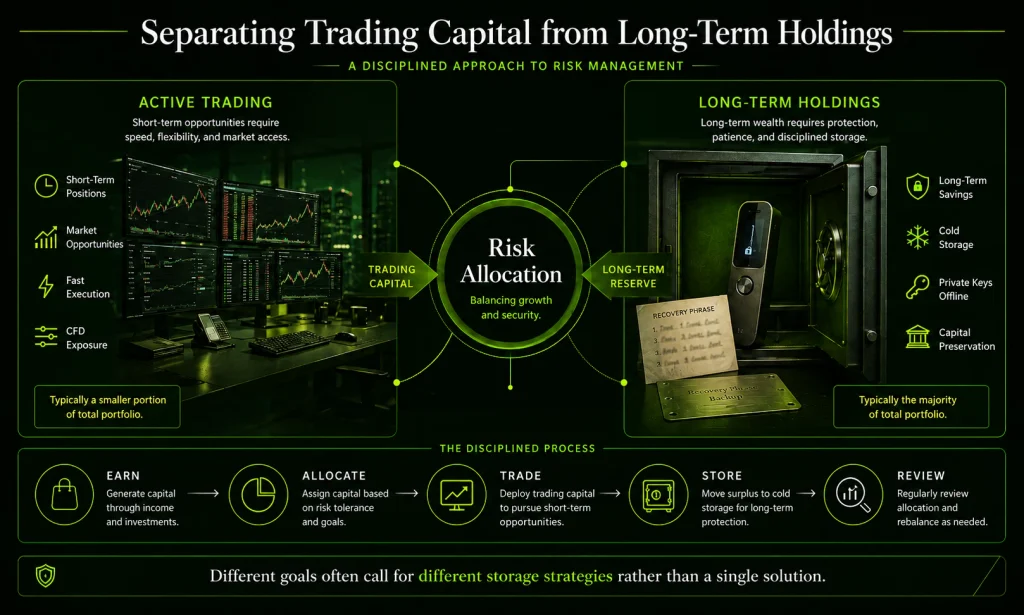
An experienced trader never puts all their capital into a single basket. They separate their capital based on utility, speed, and immediate risk control.
Recruitment Team Lead, Versus Trade — Evgeniya Romanova
If your objective is capitalizing on short-term market movements, constant price fluctuations, or regional volatility in target markets like Indonesia, moving actual crypto tokens between hardware devices is far too sluggish. Instead, active participants often look toward a dedicated CFD trading platform to speculate on price action with maximum speed and leverage, bypassing the logistical friction of on-chain network confirmations completely.
Simultaneously, you keep your foundational wealth—your long-term savings—tucked away safely inside a physical device. This hybrid approach ensures you maintain maximum market agility without ever compromising the safety of your core digital assets.
For those navigating the fast-changing world of financial technology, mastering these operational mechanics is non-negotiable. If you want to dive deeper into how industry veterans balance tech skills with market psychology, checking out insightful discussions like Why Some People Grow Fast in Fintech — And Others Burn Out Just As Fast offers an invaluable look at building long-term career resilience in this space.
Setting Up Your Cold Storage Wallet Security Without Mistakes
Setting up a cold wallet is quite straightforward, but a single careless mistake during initialization can completely ruin your security measures. Remember, the hardware is only as safe as your personal behavior. If you practice bad security habits, even the most expensive device on Earth cannot protect your assets from a determined exploit.
Critical Blind Spots to Avoid:
- Accepting pre-configured setups: If your new device arrives with a PIN code already set or a recovery phrase already filled out on a piece of paper inside the box, someone has compromised it. Real cold wallets always force you to generate these parameters cleanly on the device screen during the first boot.
- Creating digital copies of the seed phrase: Never save your recovery phrase in a Gmail folder, cloud document, smartphone screenshot, or encrypted text file. Automated malware programs actively search hard disk drive directories for strings of words that look like crypto backups.
- Skipping manual verification: When you prepare a wallet to send funds, always match every single character of the destination public address shown on your personal computer monitor with the address displayed on your physical hardware screen. Malicious browser clipboards can secretly replace copied addresses with an attacker’s address.
- Neglecting a demo run: Before sending your entire life savings to a newly configured device, perform a test run. Deposit a tiny, insignificant amount of crypto, wipe the device completely by entering an incorrect PIN code three times, and practice retrieving funds from offline storage using your written recovery phrase. Once you see the test funds safely restored, you’ll have absolute confidence in your backup.
Learning the ropes using a demo trading account on an established platform helps you master trading parameters without financial risk. Similarly, running a small test transaction on your cold wallet removes the anxiety of managing live blockchain keys.
Deep Evaluation: Pros and Cons of Going Fully Cold
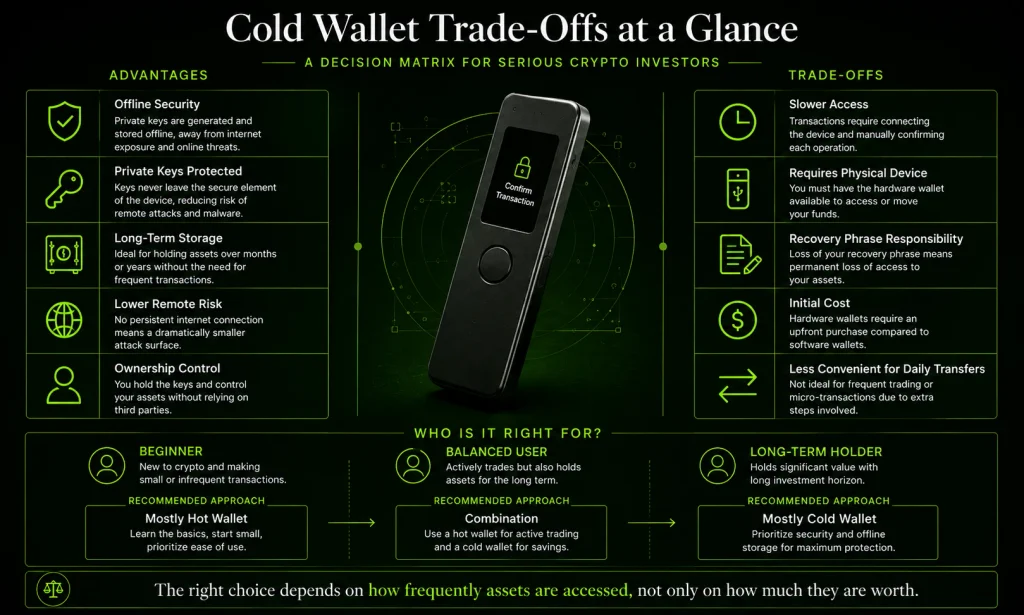
Is a cold crypto wallet an absolute necessity for every single person who owns five dollars worth of Bitcoin? Probably not. It’s a specialized tool built for specific financial realities. Let’s break down the objective realities of moving to cold storage.
The Advantages
- Absolute Asset Control: You become your own sovereign bank. No corporate entity, exchange platform, or banking infrastructure like Goldman Sachs Bank USA or Banque Delubac & Cie. can freeze your assets, restrict your withdrawals, or misuse your capital behind closed doors.
- Immunity to Remote Attacks: Even if a massive global cyberattack compromises your personal computer or web browser, your private keys offline remain safely isolated inside the physical device’s secure element.
- Peace of Mind for Long-Term Storage: For investors holding considerable positions over multiple years, it eliminates the constant anxiety of exchange insolvencies and smart contract hacks.
The Limitations
- Noticeable Friction: Cold wallets are intentionally less convenient for regular transactions. If you want to sell a token instantly during a sudden market crash, you have to find your physical device, plug it in, input your PIN, and manually approve the move.
- Unforgiving Loss Mechanics: If you lose both your physical device and your handwritten recovery phrase, there is no “Forgot Password” button. No support team can help you recover your assets. Your funds are permanently locked on the blockchain forever.
- Upfront Financial Investment: Unlike software solutions or mobile apps, which are completely free to install, high-tier hardware devices require an upfront purchase.
Conclusion: Balancing Convenience with True Risk Control
At the end of the day, securing your digital future requires a realistic assessment of your personal vulnerabilities. Relying entirely on hot storage apps leaves you exposed to a constantly shifting landscape of digital threats. Cold wallets offer an uncompromising solution for anyone who prioritizes wealth preservation over transactional speed. By shifting your core private keys into an isolated, offline environment, you effectively take your assets off the radar of global hackers.
“At the end of the day, the most important thing is how good you are at risk control. Ninety percent of any great trader is going to be the risk control.”
American billionaire hedge fund manager — Paul Tudor Jones
traderlion.com December 13, 2025
Take control of your assets, separate your daily trading capital from your core savings, and build your operational habits with the same discipline you apply to the markets. Once you master the simple balance between active trading tool accessibility and rigid offline security, you can participate in the digital asset economy with complete confidence.
Trade XAUUSD with spreads from 2.4p and zero commission per lot. When gold moves, trading costs shouldn’t steal the spotlight.

- Why Investors Move Massive Crypto Portfolios Offline
- How a Cold Wallet Works under the Hood
- Real-World Variations: Types of Cold Wallets Available Today
- Hot Wallet vs Cold Wallet: The Crucial Structural Differences
- Strategic Asset Allocation: How an Experienced Broker Manages Risk
- Setting Up Your Cold Storage Wallet Security Without Mistakes
- Deep Evaluation: Pros and Cons of Going Fully Cold
- Conclusion: Balancing Convenience with True Risk Control