
What Is CFD Trading and How Contracts for Difference Work in 2026


- How Does it Work? Mechanics of CFD Instruments in Trading
- Leverage and Margin: Capital Requirements in Stock Trading vs CFDs
- Hypothetical CFD Trade Examples
- CFD Platforms: Navigating MT4, MT5, and Modern Terminals
- Popular Trading Terminals: MT4 vs MT5
- Why Traders Consider CFDs and Risk Considerations
- Steps to Begin CFD Trading
- Trading Discipline
If you’ve spent more than five minutes looking into trading, you’ve definitely stumbled upon the term CFD. Short for Contract for Difference, it’s a financial product that lets you speculate on market movements without taking physical ownership of the underlying asset. Put simply: when you buy a CFD, you aren’t holding actual company shares, a gold bar, or a stack of cash—you’re just trading the price action. Instead, you enter a contract between two parties—the trader and the CFD broker—to exchange the difference in the value of the position between when the trade is opened and when it is closed. If the market moves in the anticipated direction, the position may produce a gross profit. The final result depends on the size of the price movement and applicable trading costs. If the market price moves against you, you pay the difference to the broker and incur a loss.
CEO, Versus Trade —Vitalii Bulynin
This financial instrument can provide exposure to a broad range of asset classes across global online financial markets, from shares and indices to commodities and forex. CFD prices generally track a referenced underlying market, although the provider determines the executable bid and ask prices under its pricing methodology.
How Does it Work? Mechanics of CFD Instruments in Trading
To understand what CFD trading is and how CFDs work, you have to look at how a contract for difference separates the price movement of an asset from its physical settlement. In traditional stock trading, buying 100 shares of a company means paying the purchase price and obtaining beneficial ownership of the security through a CFD broker or custodian.
A CFD contract uses a different structure. It is an over-the-counter derivative where the trader and the broker agree to settle the net price difference. This structure allows a CFD trader to speculate on whether the referenced market price will rise or fall without acquiring the underlying asset.
Here is the step-by-step lifecycle of how CFDs work when you open a position and close a trade:
- Select the underlying market: You choose a market—such as a stock CFD, forex pair, or index—and decide whether the market price will rise or fall.
- Determine your directional bias: If you think the price is going to rise, you open a long CFD position (buy). If you want to profit from a market drop, you can go short just as easily by placing a sell order.
- Set the position size: You select how many CFD contracts to trade. Contract sizes vary by provider and instrument. For some share CFDs, one contract represents one share, while commodity CFDs may use different contract specifications.
- Close the trade and pay the difference: When you close the CFD position, the system calculates the exact difference between the entry price and exit price. The resulting profit or loss is then reflected in the trading account, subject to applicable charges and the broker’s settlement procedures.
Because no underlying asset is delivered, CFDs avoid the physical storage associated with commodities and the transfer of securities. Currency conversion and other account charges may still apply.
Markets move fast. Get the flexibility to adjust your exposure and trade opportunities your way with leverage up to 1:2000.
Leverage and Margin: Capital Requirements in Stock Trading vs CFDs
One of the main reasons investors choose to trade CFDs over conventional asset purchases is leverage. Trading on margin allows you to gain market exposure without having to put up the entire value of the position.
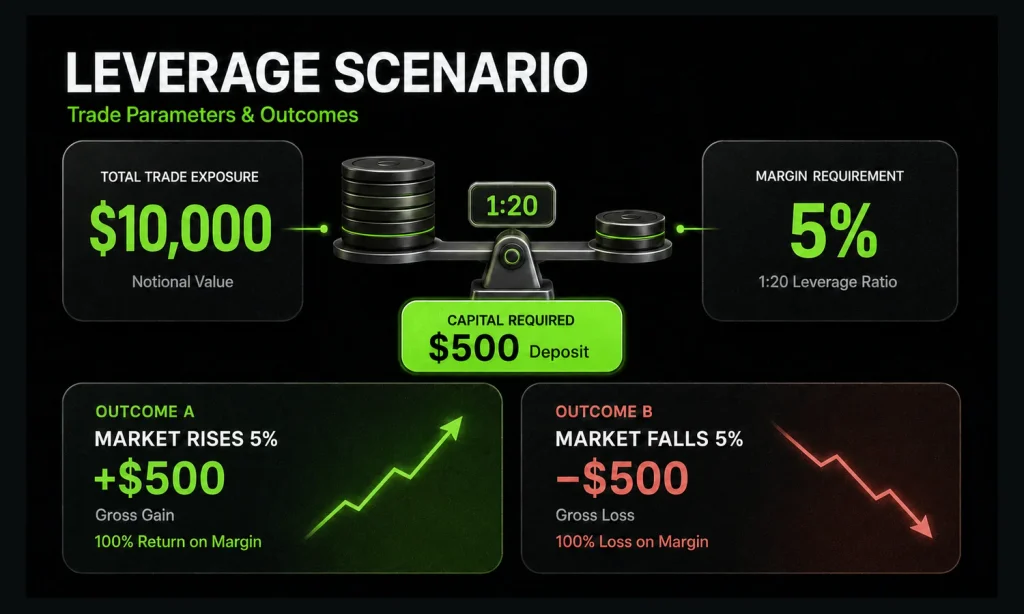
When engaging in online trading, leverage acts as a multiplier. Instead of needing $10,000 to trade $10,000 worth of stock, your CFD provider might only require a fraction of that amount as initial margin.
What Are Initial Margin and Margin Requirement?
The initial margin is the deposit required to open a CFD trade, while account equity must remain above the broker’s close-out threshold to keep a CFD position open. Margin requirements vary by asset class, client classification, broker, and jurisdiction. Under EU retail rules set by ESMA, leverage limits range from 30:1 for major currency pairs to 2:1 for cryptoasset CFDs.
Availability and regulation also depend on your country. Regulation for CFDs varies heavily depending on where you’re trading from. In the US, retail investors can’t trade standard OTC CFDs at all due to strict regulatory restrictions. Regulators in the UK, EU, and Australia do allow them within specific legal boundaries, though watchdog rules differ by asset class—the UK’s FCA, for example, completely prohibits retail crypto-asset CFDs. The required funds act as collateral against potential losses and the trader’s obligations under the contract.
Risks of Trading on Margin
While leverage can certainly boost gains when the market moves your way, the downside is just as steep. CFDs are complex products, and margin trading means your potential losses are calculated against the total position size, far exceeding your starting deposit.
The broker may close one or more positions when account equity falls below the applicable margin threshold. Negative balance protection may separately limit losses for eligible retail clients in certain jurisdictions, though this depends on local rules and client status. This is why retail investors must carefully manage their risk when learning how to trade CFDs.
Hypothetical CFD Trade Examples
To clarify how trades are calculated, let us break down two simplified scenarios: a long trade on an equity CFD and a short trade on a commodity CFD.
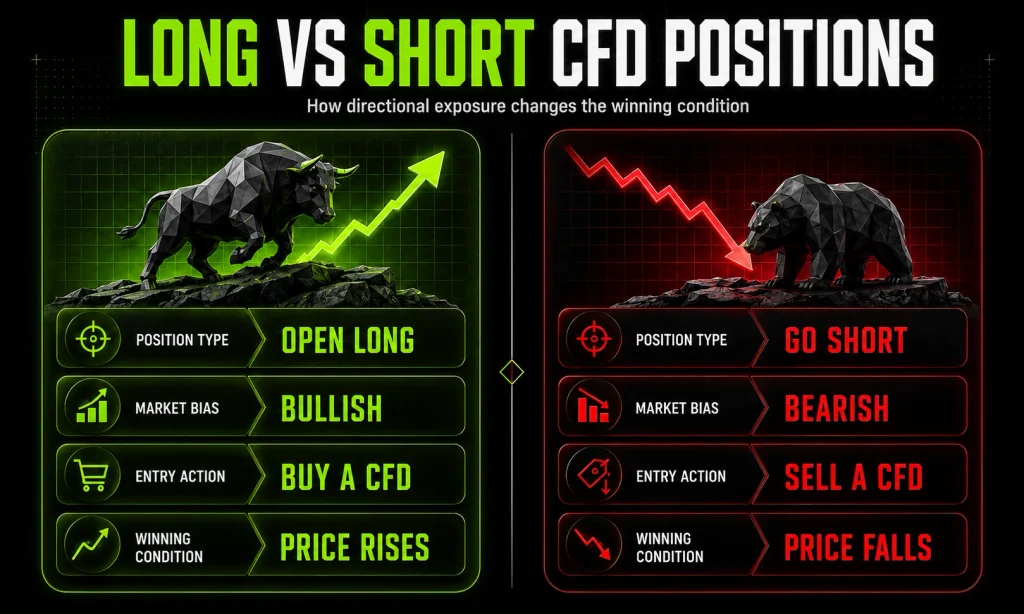
Long Position Example: How to Start, How to Trade a Tesla Stock CFD
Imagine buying 100 Tesla CFD contracts at $200 a piece, as explained below. Your full position size is $20,000, but because of a 20% margin requirement, you only lock up $4,000 of your account balance.
The Bull Case: Tesla stock goes up to $220. Closing the trade gives you a $20 gain per contract, totaling $2,000 in gross profit—effectively a 50% return on your $4,000 outlay.
The Bear Case: Unexpected supply chain issues drag the stock down to $180. That $20 price drop per contract leaves you with a $2,000 gross loss.
Note: Gross P&L figures do not include spreads, commissions, financing costs, or currency conversion charges.
Short Position Example: Shorting Gold When Prices Fall
In a second hypothetical example, assume the referenced gold price is $2,000 per ounce. You observe macroeconomic shifts and anticipate that spot gold is set to decline.
When you go short by opening a sell CFD order for 10 units of gold at $2,000, your notional value is $20,000. At a 5% margin requirement (1:20 leverage), you need a $1,000 deposit. If gold falls to $1,950, you buy back the contracts to close the position. That $50 price drop yields a $500 gross profit ($50 × 10 units). A rally to $2,050 generates a $500 gross loss.
Note: Gross results exclude spreads, broker commissions, holding costs, and currency conversion fees.
CEO, Factor LLC — Peter Brandt
Navigating financial markets requires understanding broader career shifts in the trading landscape. Check out the article “The Real Reason You’re Not Getting Hired in Fintech” for a breakdown of modern hiring dynamics in high-frequency trading and brokerage firms.
Explore the CFD markets available through Versus Trade.
CFD Platforms: Navigating MT4, MT5, and Modern Terminals
Executing a trading strategy requires tools you can master. Modern trading platforms provide the infrastructure necessary to analyze price charts, manage orders, and monitor positions.
When choosing a CFD provider, traders usually encounter two primary categories of platforms: third-party software and proprietary web terminals.
Popular Trading Terminals: MT4 vs MT5
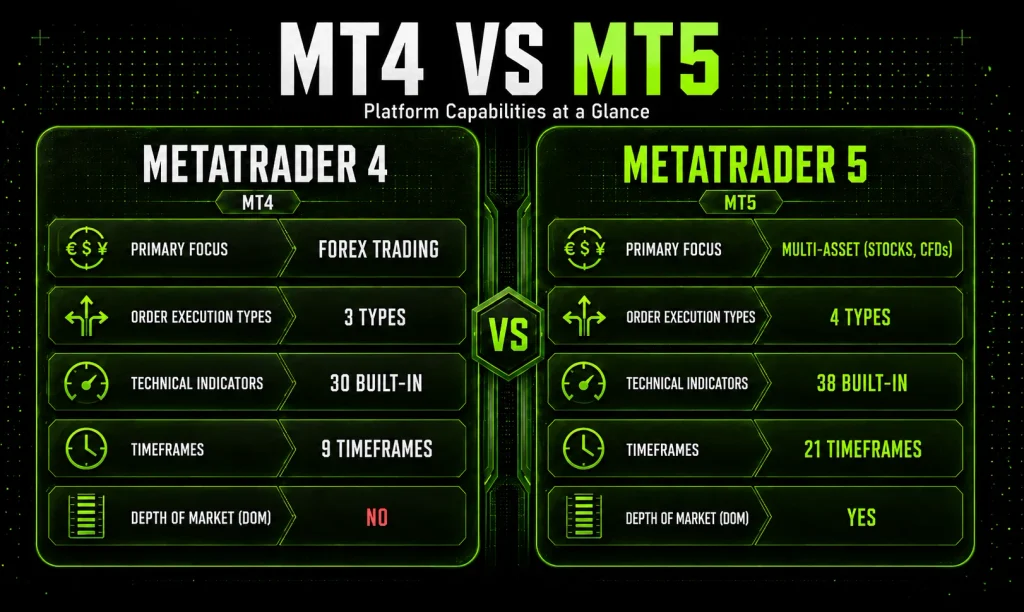
The industry standards for retail trading software remain MT4 and MT5 (MetaTrader 4 and MetaTrader 5), offering stable execution, automated trading capability, and multi-asset charting. MT4 remains renowned for its stability and ecosystem of automated algorithms (Expert Advisors), optimizing primarily for foreign exchange and basic CFD instruments. Conversely, MT5 provides the multi-asset successor model, offering expanded charting tools, depth of market (DOM) data, 21 timeframes, and advanced backtesting capabilities. Actual execution speed across both terminals remains dependent on broker infrastructure and liquidity pools.
In addition to MT4 and MT5, Versus Trade offers web and mobile interfaces for trade management and chart analysis.
Asset Classes Available for CFD Trading
A main feature of maintaining a CFD trading account is access to multiple asset classes through one trading account, including Forex (major and exotic currency pairs), Indices (broad basket performance like the S&P 500), Shares (individual equities), Commodities (energy and precious metals), Cryptocurrencies (where permitted by law), and Futures-referenced markets (derived from underlying interest rates or commodity futures).
Why Traders Consider CFDs and Risk Considerations
When asking why I should trade CFDs, retail investors often look at the structural flexibility, lower initial capital requirements, and portfolio hedging mechanisms.
Key Characteristics: Flexibility and Market Access
One primary reason traders ask why trade CFDs comes down to capital efficiency: margin trading allows you to gain exposure without committing full cash value.
- Trade Both Ways: CFDs can make short exposure operationally simpler than borrowing shares through a conventional brokerage account, although other instruments can also provide bearish exposure.
- Capital Usage: Leverage leaves more account capital uncommitted, but spreading leveraged positions across several markets does not necessarily reduce portfolio risk.
- Portfolio Hedging: A short CFD position may offset part of a decline in the shares, although the effectiveness of the hedge depends on position size, pricing differences, and trading costs.
- Market Access Hours: Trading hours vary by underlying market. Forex and some index CFDs may trade nearly 24 hours a day during the working week, while share CFDs generally follow exchange or extended-market sessions.
Risk Management Tactics
Because CFDs are complex instruments, high market volatility can lead to capital depletion if positions are left unmanaged.
To mitigate risks, traders use standard stop-loss orders to trigger a closing order at a chosen level, though execution prices may differ during market gaps unless guaranteed stops are offered. Take-profit orders can close a position once a selected level is reached, although the final execution price may vary under the broker’s order policy and prevailing market conditions. Some traders use position-sizing limits, such as targeting 1–2% of account equity per trade, although gaps, slippage, and correlated positions can cause actual losses to exceed the intended amount. Utilizing a demo trading account allows beginners to practice execution parameters without placing real capital at risk.
Steps to Begin CFD Trading
Getting started with CFD trading requires a methodical onboarding process.
- Select a Licensed Broker & Open Account: Choose an established CFD provider, review licensing, fee structures, and market access options.
- Complete Identity Verification & Deposit Funds: Pass standard compliance checks (KYC) and fund your account using available payment methods.
- Test Execution Strategies on a Demo Account: Practice order entry, risk parameters, and position sizing in a simulated market environment.
- Select Asset, Apply Stop-Loss & Open First CFD Trade: Choose your desired market, set strict risk management controls, and execute your order.
Trading Discipline
Learning to trade CFDs is an ongoing process of discipline, record-keeping, and risk assessment. A majority of retail CFD accounts lose money at many providers. Leverage, trading costs, market volatility, and trading behavior can all contribute to these losses.
To navigate this market, maintain a structured approach: keep a trading journal, monitor leverage exposure, and focus on risk management.
Explore the CFD markets available through Versus Trade.
Forex, metals, indices, crypto, commodities and more. Find your market and make your move – all on MT5.

- How Does it Work? Mechanics of CFD Instruments in Trading
- Leverage and Margin: Capital Requirements in Stock Trading vs CFDs
- Hypothetical CFD Trade Examples
- CFD Platforms: Navigating MT4, MT5, and Modern Terminals
- Popular Trading Terminals: MT4 vs MT5
- Why Traders Consider CFDs and Risk Considerations
- Steps to Begin CFD Trading
- Trading Discipline