
Master the Markets: How to Day Trade Without Losing Your Mind


- What Is Day Trading and How Does It Work?
- The Raw Reality: Why Do Most Day Traders Fail?
- How Can I Earn $1000 Per Day Day-Trading?
- Day Trading vs. Swing Trading: Finding Your Style
- How Much Capital Is Needed to Start Day Trading? Can I day trade with $100?
- How to Start Day Trading for Beginners: 4 Practical Steps
- What Are the Best Day Trading Strategies for Beginners?
- What Tools and Resources Do Day Traders Use?
- The Clock Matters: What is the Best Time to Day Trade?
- What Are the Rules and Regulations for Day Trading?
- What Are the Risks of Day Trading? Golden Tips for Ironclad Risk Management
- Conclusion: Your Day Trading Journey Starts Today
Let’s be completely honest right from the start. If you’ve spent any time on social media lately, you’ve probably seen the glamorous side of the market. Flashy cars, laptop screens overlooking a beach in Bali or Lombok, and promises of making a fortune by lunch. It looks like the ultimate dream. But if you walk into this thinking it’s an easy ticket to early retirement, the market will take your money before you can even finish your morning coffee. Day trading isn’t a relaxed lifestyle hobby; it’s a high-stakes, fast-moving profession that requires razor-sharp discipline.
What Is Day Trading and How Does It Work?
To understand the basics of how to day trade, we must break down what happens behind the screens on an average day. In simple terms, day trading involves buying and selling financial instruments within a single session. This form of active trading means that a stock trader, forex speculator, or crypto enthusiast opens and closes trading positions rapidly, never holding assets overnight.
But how does day trading work in practice? It relies entirely on short-term market volatility. A day trader’s objective is to extract a small profit from short-term movements in a financial instrument, such as a stock, currency pair, or futures contract. When high trading volumes hit the stock market or the foreign exchange market, prices fluctuate. The trader uses a regulated broker and a high-speed trading platform to execute orders, utilizing short-term fluctuations to buy low and sell high—or short (finance) an asset to profit as the price drops.
For a dummy who thinks this is just gambling, it looks chaotic. But for professionals, day trading is a strategy built on statistics. You are not buying a company because you believe in its 10-year growth. You are trading the news, corporate data, or a clear market trend over a time horizon of minutes or hours. Once the closing bell rings, you cash out. No overnight risk. No waking up to find a global crisis wiped out your capital.
The Raw Reality: Why Do Most Day Traders Fail?
Forget about quick cash here; let’s just get straight to the point. The main thing everyone wants to know is, is day trading profitable for just anyone? Not at all. Various studies from the financial industry are brutal: day traders lose money in staggering numbers.
So, why do most day traders fail?
- Emotional overreaction: They lose a trade, snap, and try to force a win back out of pure anger. That’s a fast track to a margin call. If you don’t learn how to discipline your mind and avoid emotional trading, the market will eat you alive.
- Lack of structure: They trade without a strict, tested trading plan.
- Misunderstanding leverage: They over-leverage their trading account, thinking it’s a shortcut to wealth, only to trigger a sudden margin call.
Success in this field requires an understanding of how modern retail markets operate. You aren’t just competing against another retail investor in Jakarta. You are competing against massive institutional trading desks, multi-billion-dollar hedge fund algorithms, and high-frequency trading systems. Furthermore, global macroeconomic conditions—including shifting central bank policies, fluctuating interest rate targets, and intense movements in tech giants like Nvidia—mean that the trading environment can change in a heartbeat.
Because of this intense atmosphere, day trading demands total commitment. If you do not treat this as a serious business, day trading is often a fast track to financial ruin. Many people enter the industry expecting instant results, which is why they burn out. This reality is identical across the entire fintech sector. In fact, if you look at how professionals discuss development on social platforms, the themes are identical. As noted in a recent Versus Trade LinkedIn article, “Why Some People Grow Fast in Fintech—And Others Burn Out Just As Fast”, the difference between survival and failure comes down to the environment you build around yourself and how you handle pressure.
To thrive, you need a solid foundation of trust, patience, and continuous learning. This sentiment is echoed perfectly by industry leaders who manage teams under this exact kind of pressure:
HR Business Partner, Versus Trade — Karina Matkovska
Look, successful day trading isn’t about being right every time. The reality is that trading can be profitable only when you shift your mindset to raw probabilities. You have to study behavioral economics just to understand why everyone else is losing money, master your own strategy’s statistics, and stop letting every tick on the chart trigger a mini-panic attack.
How Can I Earn $1000 Per Day Day-Trading?
It’s the question everyone whispers: How can I earn $1000 per day? Let’s look at the math behind how day traders make money to demystify this goal. To generate a consistent $1,000 every single trading day to profit, your strategy, trading capital, and position sizing must be completely aligned.
Think about it: if you have a tiny trading account, squeezing $1,000 out of it every day forces you to use massive, incredibly risky leverage (finance). If you’ve only got $2,000 on deposit, aiming for a grand a day means you need a 50% return every single session. That’s just financial suicide.
Success in day trading requires a clear understanding of reality: professional risk management dictates that you should only risk 1% of your capital per trade. If your strategy has a 1:2 risk-to-reward ratio, you need a substantial account size—often north of $50,000—to safely net $1,000 a day without exposing yourself to a total wipeout.
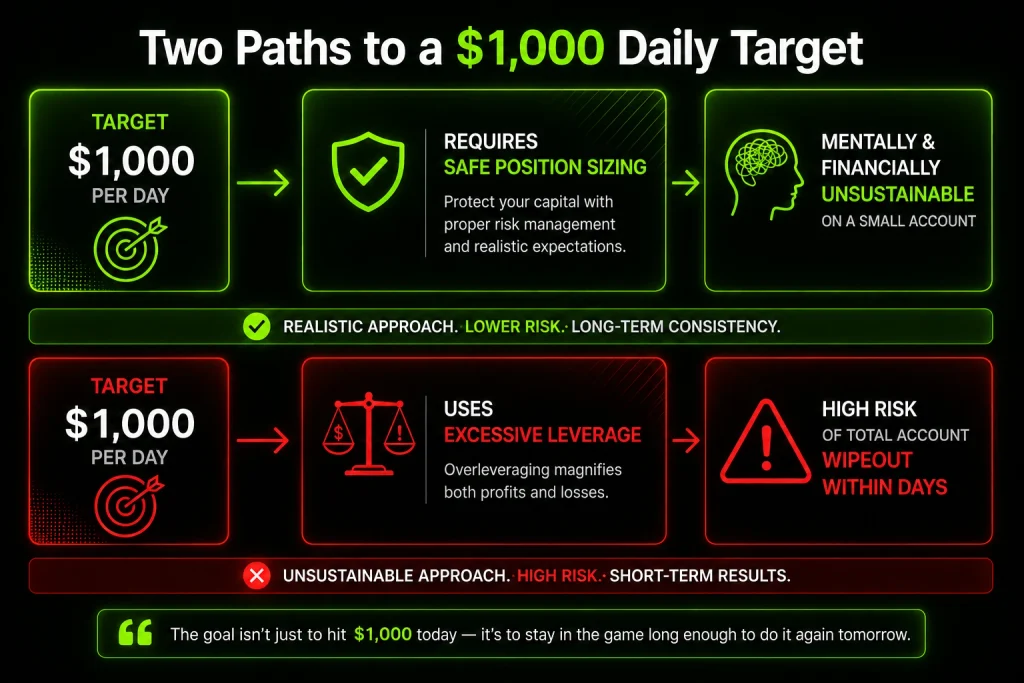
When a beginner focuses strictly on a fixed monetary target rather than market setups, they force bad trades, ignore their indicators, and experience massive day trading profits followed by even larger, catastrophic losses. Day trading is a strategy, not a magic cash machine. Focus on execution, and the numbers will follow.
Day Trading vs. Swing Trading: Finding Your Style
Before you deposit any funds, you must decide if entering trades within the same trading day actually fits your personality, schedule, and lifestyle. The biggest point of confusion for a beginner is the distinction between day trading vs. swing trading. Both can be highly effective investment strategies, but they require completely different operational frameworks.
| Feature | Day Trading | Swing Trading |
| Holding Period | Seconds to hours (never overnight) | Days to several weeks |
| Time Commitment | High (requires constant chart monitoring) | Medium (a few hours a week for analysis) |
| Transaction Volume | High (multiple trades per day) | Low (a few carefully selected setups a week) |
| Impact of Leverage | High reliance on intraday leverage | Lower reliance; focus on larger structural trends |
| Psychological Stress | Intense, rapid decision-making | Moderate; requires patience to let setups develop |
An average day for a day trader involves intense focus during specific market hours. You are looking at minor price fluctuations, exploiting immediate market anomalies, and utilizing heavy trading volume to get in and out of positions quickly. Because you close everything before the closing bell, overnight news won’t affect you.
Swing trading, on the other hand, is a more patient approach. Swing traders look at a more extended market trend. They buy an asset because they believe it is undervalued and hold it to profit from a larger price swing over days or weeks, using a standard buy and hold core concept but with shorter horizons. For many people with full-time jobs, swing trading is a far more realistic starting point because it doesn’t require you to stare at a terminal all day.
If you choose the path of intraday action, remember that day trading demands your full attention. It is a grueling job, and if you try to do it casually while distracted, you will burn through your cash rapidly.
Every pip counts. Trade with paper-thin spreads built to keep more of every market move in your hands.

How Much Capital Is Needed to Start Day Trading? Can I day trade with $100?
Let’s address the most common financial barrier for retail investors. How much capital is needed to start day trading effectively? If you read a standard online day trading guide, it might tell you that you need tens of thousands of dollars to even look at the markets. But let’s look at cash in the micro-reality: can I day trade with $100?
Technically, yes. Thanks to modern digital brokers, beginners can start with as little as $100, especially if they focus on cryptocurrency or micro-lots in the foreign exchange market. A small deposit allows you to trade fractions of an asset, meaning you can practice your executions without massive financial strain. Trading with real money—even just a $100 account—is highly educational because it introduces the real element of emotion that a simulator without trading capital cannot replicate.
However, we must be brutally realistic about the math of a small balance:
The Reality of a $100 Account: If you practice proper risk management and risk 1% per trade, you are risking exactly $1. To make a meaningful profit, you would have to use extreme leverage, which means a single minor market move against you will liquidate your position.
Therefore, a $100 account is fantastic for learning the basics of day trading, mastering your software settings, and testing your execution speeds. But it is completely inadequate for making a living or generating sustainable day trading profits. If your goal is to build a professional income, you must view your initial small account as an educational tool, not a wealth generator.
How to Start Day Trading for Beginners: 4 Practical Steps
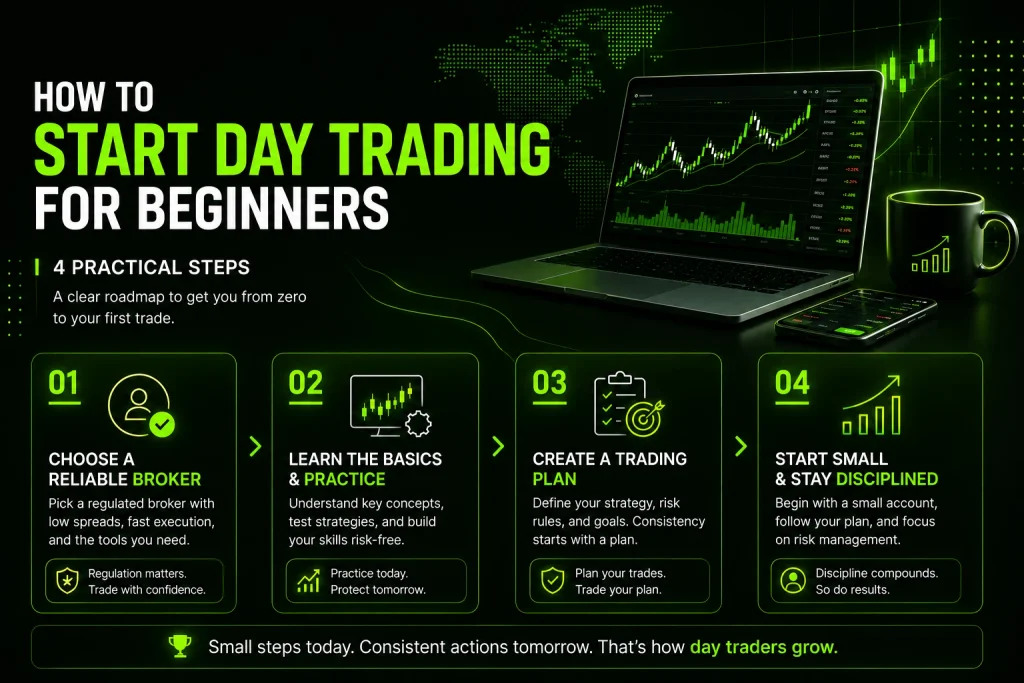
If you know the risks and still want to move forward, you need a tight, no-nonsense game plan. You can’t just open a random chart, click a few buttons, and pray that the market moves your way. Getting started properly requires a systematic approach to the market infrastructure.
Step 1: Secure Your Risk Capital
As we discussed, your initial capital must be money you can afford to lose completely. If you are using funds meant for daily living expenses, the psychological pressure will distort your judgment, leading to catastrophic mistakes. Treat your initial balance as an educational tuition fee for the market.
Step 2: Choose a Reliable Broker and Platform
Your choice of a broker is your most critical strategic partnership. You need a regulated trading platform that won’t lag when the market goes crazy. Look for an interface loaded with fast trading tools and live, tick-by-tick market data that actually keeps up with price action. If your software freezes during a high-volatility event, you won’t even have time to close your position before your balance hits zero. To get a feel for the execution speeds and layout, it is highly recommended to open a demo trading account first. This allows you to test the software infrastructure without risking your savings.
Step 3: Master Technical Analysis and Indicators
You cannot trade based on a “gut feeling.” You must learn how to interpret price action through technical analysis. This involves studying historical price charts to identify repeatable patterns. You don’t need twenty tools on your screen. Just focus on a basic technical indicator setup—maybe a moving average to catch the high-level momentum and the Relative Strength Index (RSI) to see if the price is overextended. Keep your charts clean. A cluttered layout leads to serious analysis paralysis, and in this game, hesitation costs cash.
Step 4: Build a Strict Trading Plan
Before you enter any live session, you must write down your rules: what assets you will trade, what times you will be active, your maximum daily loss limit, and your precise entry and exit triggers.
Ready to Test Your Skills in the Market?
Don’t risk your capital until you’ve mastered the platform mechanics. Sign up today and get access to professional-grade tools, real-time data, and a secure environment built for traders of all levels.
What Are the Best Day Trading Strategies for Beginners?
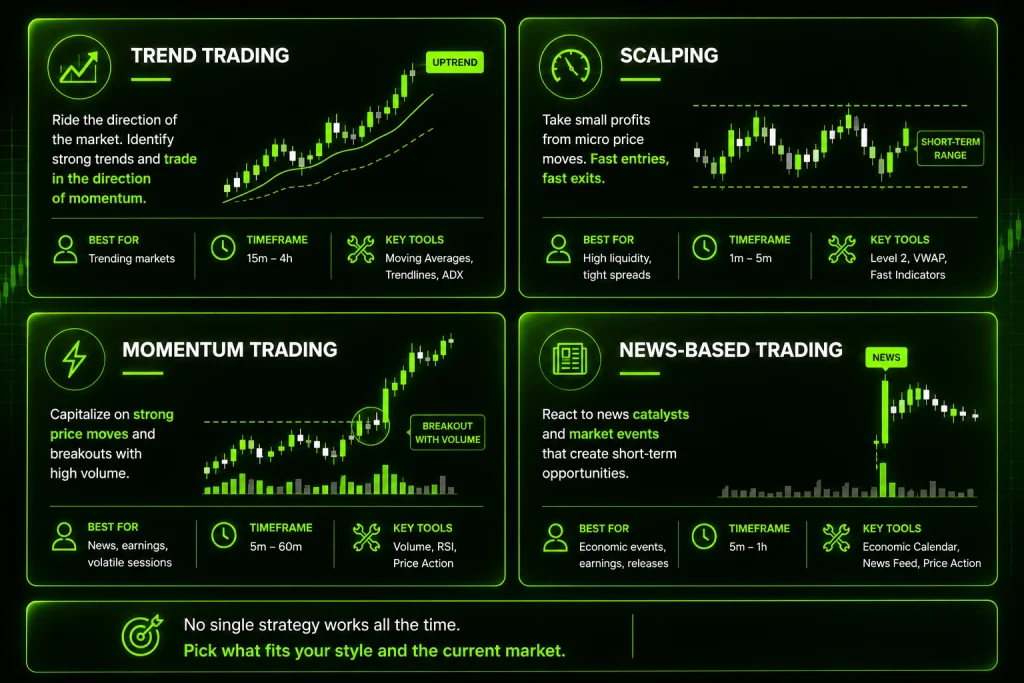
To survive, you need a repeatable edge. A trading edge is a specific set of criteria that, when met, provides a statistical probability of a positive outcome over a large sample of trades. Here are the most accessible and popular day trading strategies used by retail and institutional professionals:
Trend Trading
This classic approach involves identifying the primary direction of the market and only taking positions in that direction. If the asset is making higher highs and higher lows on the chart, you look for buying opportunities on temporary pullbacks. Trend trading works because it aligns you with institutional capital flows, meaning you are riding the wave rather than trying to stop it.
Scalping
This is an aggressive, high-speed style where the trader holds positions for mere seconds or minutes. When you choose trading or scalping, you’re basically hunting for micro-moves caused by split-second imbalances in buying and selling pressure. You execute dozens of fast trades a day, banking tiny profits over and over while cutting losses instantly. It’s stressful, but it keeps your overnight risk at zero. It requires intense focus and is highly sensitive to broker fees.
Momentum Trading
With momentum trading, you aren’t trying to predict reversals. You are looking for a runaway train—an asset surging or dumping in massive volume because of a surprise earnings report or a major economic data release. Your only job is to catch a piece of that fast move and get out before it stalls. The goal is to hop on the moving train, ride the acceleration, and exit the moment the volume starts to dry up.
News-Based Trading
The whole point of news-based trading is to catch the absolute chaos that follows major announcements. Think of it like this: Nvidia beats its revenue targets, the stock starts flying pre-market, and you try to trade that massive price rip. It sounds easy, but it’s incredibly risky because order execution gets messy and spreads blow out the moment the numbers hit the tape.
What Tools and Resources Do Day Traders Use?
You cannot participate in modern markets without the proper equipment. Relying on a slow mobile phone app and a spotty cellular connection is a guaranteed way to lose your funds. Professional day trading demands a dedicated setup.
Your physical trading tools start with a high-spec computer that won’t lag when processing live streaming charts. Next, lock down a blazing-fast internet line with a mobile hotspot backup—because if your fiber drops mid-trade, you are blind.
On the software side, you need charting setups that feed you real-time market data down to the split second. Most pros also run a real-time scanner to filter thousands of stocks, crypto pairs, or commodity trading assets, instantly flagging where the sudden volume and massive volatility are hitting.
Finally, get a trading journal. If you aren’t logging your metrics, you’re just playing a video game with your savings, and you cannot analyze your performance successfully.
The Clock Matters: What is the Best Time to Day Trade?
The financial markets are not equally active throughout the twenty-four-hour cycle. The best time to day trade is during periods of maximum liquidity and high asset movement.
For the stock market, the most volatile and liquid periods are the opening and closing hours of the major exchanges. The first 60 to 90 minutes after the opening bell of major markets like the Nasdaq represent a prime window. This is when the market digests overnight news, leading to sharp, predictable trends that benefit day traders. The final hour of the session also sees a massive surge in institutional volume.
If you are trading the foreign exchange market (Forex) or futures trading contracts, the best windows occur when major regional sessions overlap—such as the London and New York crossovers. For traders operating out of Southeast Asian time zones like Indonesia (WIB/WITA), this means your prime trading windows often fall in the late afternoon and evening, allowing you to watch the major Western market opens without having to disrupt your regular sleep cycle.
What Are the Rules and Regulations for Day Trading?
If you plan to target assets listed in the United States, you have to play by some incredibly strict trading rules meant to stop retail accounts from blowing themselves up. The absolute biggest hurdle is the Pattern Day Trader rule (PDT). This is a heavy regulation backed by the Financial Industry Regulatory Authority (FINRA) and the United States Securities and Exchange Commission (SEC). Under this exact pattern day trader rule, if you execute four or more intraday positions within five rolling business days using a standard margin (finance) account, they label you a PDT trader. Once that happens, you are legally locked into a massive capital requirement—you must keep at least $25,000 in your equity balance at all times or your execution privileges get frozen until you top up the cash balance.
This rule catches many international beginners completely off guard. If you don’t have $25,000 to start with, you have a few structural alternatives to explore:
- You can choose to trade CFD contracts or trade spot forex and cryptocurrencies, which are typically governed by different regional frameworks and do not carry the rigid $25,000 PDT restriction.
- You can utilize a cash-only account for stocks, though this means you cannot use leverage and must wait multiple days for your transaction funds to clear before using them again.
Regardless of your path, understanding local and global regulation is vital to ensure your funds remain secure and accessible. Day trading is legal worldwide, but you must operate within the boundaries of your chosen asset class’s legal framework.
What Are the Risks of Day Trading? Golden Tips for Ironclad Risk Management
Let’s be completely direct: you can have the most advanced technical indicators, the fastest computer, and a brilliant understanding of market trends, but without strict risk management, you will inevitably blow up your account. Top-tier traders do not focus on how much money they can make; they are obsessively focused on preserving their remaining capital. Trading is not suitable for anyone who cannot tolerate financial uncertainty.
To survive, you need a strict, objective plan that dictates your actions before the market opens. Here are a few essential tips to ensure you keep your emotions in check and manage your downside effectively:
- The 1% Rule: Never risk more than 1% of your total account equity on a single trade. If you have a $10,000 account, your maximum loss on any single position should be capped at $100. Even if you hit an atrocious losing streak of ten trades in a row, you will still have 90% of your capital intact to fight another day.
- Always Use a Stop-Loss Order: A stop-loss is an automated instruction you give to your platform to close out your position once the price hits a specific level against you. It acts as your ultimate circuit breaker, preventing a small mistake from turning into a life-altering financial catastrophe.
- Avoid Emotional Trading: The market is a mirror of human psychology. When you lose money, your brain screams at you to enter another trade immediately to win it back—this is called “revenge trading.” Conversely, when you win, greed can make you over-leverage your positions. Stick to your statistical rules, use protective risk management tools, and walk away from your screen when your daily loss limit is hit.
American billionaire — Stanley Druckenmiller,
quoted in Jack Schwager’s The New Market Wizards (1992)
By treating every position as a calculated, statistical event rather than a personal bet on your ego, you insulate your capital from emotional biases and give your portfolio the structural room it needs to grow.
Conclusion: Your Day Trading Journey Starts Today
Jumping into the markets for the first time is brutal, and there are absolutely no shortcuts to figuring out these charts. It takes hours of screen time, endless practice, and the humility to accept when you’re dead wrong. At the end of the day, day trading is nothing more than a strict discipline of probabilities, ironclad risk management, and total self-control. Find a solid broker, learn the rules, and protect your cash like a hawk. Your day trading journey isn’t going to be a sprint—it starts with patience and building your edge step by step.
Markets move fast. Get the flexibility to adjust your exposure and trade opportunities your way with leverage up to 1:2000.

- What Is Day Trading and How Does It Work?
- The Raw Reality: Why Do Most Day Traders Fail?
- How Can I Earn $1000 Per Day Day-Trading?
- Day Trading vs. Swing Trading: Finding Your Style
- How Much Capital Is Needed to Start Day Trading? Can I day trade with $100?
- How to Start Day Trading for Beginners: 4 Practical Steps
- What Are the Best Day Trading Strategies for Beginners?
- What Tools and Resources Do Day Traders Use?
- The Clock Matters: What is the Best Time to Day Trade?
- What Are the Rules and Regulations for Day Trading?
- What Are the Risks of Day Trading? Golden Tips for Ironclad Risk Management
- Conclusion: Your Day Trading Journey Starts Today