
Day Trade: Beginner Day Trading Strategies for More Structured Decisions


- What Does It Mean to Day-Trade?
- What a Beginner Day Trader Actually Needs
- Five Popular Day Trading Strategies
- How Stock Day Trading Differs From Forex
- Risk Management Behind the Best Day Trading Strategies
- A Beginner Trading Plan for One Setup
- Day Trading Versus Swing Trading
- How to Start Day Trading Without Strategy Hopping
- Day Trading Tips That Survive Different Markets
- The Strategy Is Only the Starting Point
A quiet chart can become disorderly in seconds. A data release lands, liquidity shifts, and price suddenly crosses several levels. Opportunity and risk arrive together.
That rhythm separates day trading from slower investment strategies. Positions normally close within the same trading day, removing overnight exposure but compressing decisions. Transaction costs accumulate across repeated trades.
Forex, indices, commodities, and shares can all produce meaningful intraday price movement. Yet activity alone is not an edge. Successful day trading depends on a repeatable setup, defined entry and exit rules, controlled position size, and the patience to leave mediocre trades alone.
What Does It Mean to Day-Trade?
To day trade is to buy and sell, or sell and buy, a financial instrument before the trading session ends. Holding periods may last from seconds to several hours. The shared feature is that the position does not remain open overnight.
That definition covers very different forms of short-term trading. A scalp may target a small move during high volume, while a trend trade can remain open through most of the session. Each approach places different demands on execution speed and risk tolerance.
The market also shapes the working day. Bursa Malaysia equities trade in morning and afternoon sessions, while forex runs across the major Asian, European, and US sessions. A Malaysian trader following US indices may therefore be active late in the evening. A workable schedule must fit real availability, not merely the period with the most volatility.
What a Beginner Day Trader Actually Needs
A beginner needs tools that answer four questions: what market is active, where the trade becomes valid, where the idea fails, and how much capital is exposed if it does.
A Market With Tradable Liquidity
Liquidity influences spreads and execution. Major forex pairs and widely followed indices often attract deep participation during busy sessions. Individual day trading stocks vary more sharply. A low-volume stock can gap between prices and make a stop harder to execute as expected.
Access also depends on account type, instrument, and jurisdiction. If you want to compare pricing or execution conditions, you can review what it takes to open a professional day trading account. Versus Trade uses this page for its Pro and Raw Spread trading account options, not for any regulatory classification of you as a professional client. Spreads, commissions and leverage all shape a trading strategy and its risk management, but no account label produces successful day trading on its own.
Every pip counts. Trade with paper-thin spreads built to keep more of every market move in your hands.

A Chart That Supports Decisions
Day trading charts organise price, time, and trading volume. Candlesticks show behaviour within each interval; a moving average can frame direction, and support or resistance marks previous areas of buying and selling. A higher time frame provides context, while a lower one helps define entry and exit. None predicts the next move on its own.
CEO and Founder, Versus Trade — Vitalii Bulynin
A Written Risk Limit
Risk is clearer before the order. If an account contains $2,000 and the limit is 0.5% per trade, the maximum planned loss is $10 before slippage and costs. Stop distance then determines position size. A wider stop requires a smaller position. Leverage only makes larger exposure available.
Five Popular Day Trading Strategies
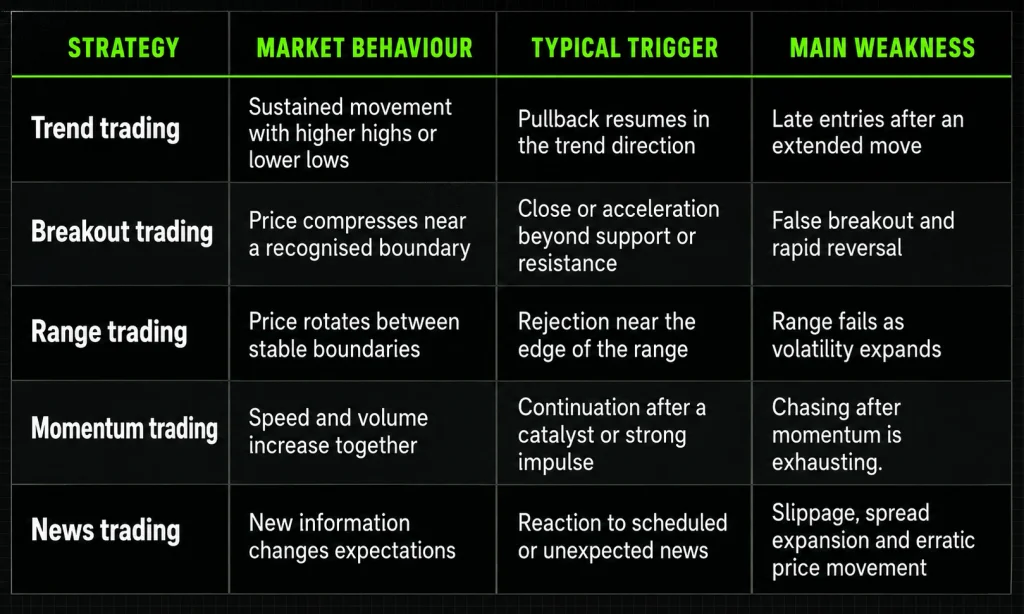
The most popular day trading strategies recur because markets repeatedly move through trends, ranges, breakouts, and failed moves. Their names are less important than their conditions. A momentum trading strategy used in a flat session can create a string of false starts. Range trading applied during a strong directional move can leave the trader repeatedly positioned against the market.
1. Trend Trading Around Pullbacks
Trend trading starts with direction. In an upward session, buyers accept higher prices and pullbacks remain contained. A previous breakout level or intraday support may provide a retracement entry. The stop normally sits beyond the structure that justified the trade.
2. Breakout Trading After Compression
A breakout occurs when a price moves beyond a recognised boundary. The better examples often begin with contraction: candles narrow, trading volume becomes restrained, and repeated tests cluster near support or resistance. Expansion then signals that one side has taken control.
Some breakouts trigger orders and then reverse through the level. Confirmation can come from a candle close, rising volume, or a retest that holds, although more evidence usually means a less favourable entry. These trade-offs can be tested without immediate capital exposure when traders open a free day trading demo account.
3. Range Trading Between Defined Levels
In a stable range, buyers appear near support and sellers return near resistance. A range trader looks for rejection at those edges and avoids the middle. Repeated tests can weaken a level, and a catalyst may turn the range into a directional move. A stop beyond the boundary acknowledges that the environment has changed.
4. Momentum and Scalp Setups
Momentum trading follows acceleration after events such as earnings or inflation data. Rising volume can keep the move active beyond the first impulse. Scalping works on a shorter horizon, where spread, commission, and slippage take a larger share of the outcome. Fast movement is not automatically good movement, especially after several extended candles.
5. News Trading Without Predicting the Headline
News trading is built around a catalyst, but the first reaction can mislead because markets trade against expectations. Spreads may widen, stops can slip, and reversals can punish either direction. Some experienced day traders wait for volatility to settle, while others avoid the event.
How Stock Day Trading Differs From Forex
The same pattern behaves differently across instruments. A stock trades around exchange hours and company news. Forex reflects two currencies across global sessions. Commodities respond to supply, demand, and geopolitics.
For shares, the open can carry high volume as overnight orders meet the market. Activity may then quieten before returning near the close. If you want exposure to international companies through stock CFDs, you can trade popular global stocks on MT5. A stock CFD is a financial instrument that does not give you ownership of the underlying shares. Contract specifications, trading hours, and costs also differ by instrument.
What Is the Pattern Day Trader Rule and the $25,000 Rule?
The former US pattern day trader rule applied to margin accounts at FINRA-member firms. A customer was generally classified as a pattern day trader after making four or more day trades within five business days, provided those trades represented more than 6% of total trades in the account over that period. The designation brought a $25,000 minimum-equity requirement and limited day-trading buying power, generally to four times the account’s maintenance-margin excess from the previous close.
Those provisions are being phased out. FINRA’s new intraday margin standards took effect on 4 June 2026, but member firms have until 20 October 2027 to complete the transition. A firm may therefore keep applying the former PDT requirements until it moves to the new framework. Once the transition is done, the pattern day trader designation and its $25,000 threshold are replaced by margin requirements tied to the exposure held during the trading day. Firms may monitor positions in real time or calculate an intraday margin deficit after the session, and their own house requirements may be stricter. The change concerns US margin accounts and does not create a Malaysian definition of a day trader.
Risk Management Behind the Best Day Trading Strategies
A chart entry is visible, but risk decisions determine whether one wrong trade remains ordinary or disrupts the account and the next decision.
Position Size Comes From the Stop
If a setup becomes invalid 20 points from entry and planned risk is $15, position size must make that adverse move worth approximately $15 after costs. Doubling the position because the trade “looks stronger” doubles the consequence if it fails.
Daily Limits Interrupt Loss Chasing
Losses can change behaviour before damaging the account. Entries become faster and standards loosen. A daily limit, expressed as a percentage, fixed amount, or number of full-risk losses, prevents frustration from increasing exposure.
Fund manager and industry expert — Jack Schwager
Reward-to-Risk Is an Estimate, Not a Promise
A target twice as far from entry as the stop is described as 2:1 reward-to-risk. The ratio says nothing about probability. Frequent small winners can still be overwhelmed by uncontrolled losses. Spread, commission, and slippage also mean that a journal works better with net results.
Do 97% of Day Traders Really Lose Money?
The figure comes from a real study, but it is not a universal failure rate. In Day Trading for a Living?, Fernando Chague, Rodrigo De Losso, and Bruno Giovannetti examined people who began day trading Brazilian equity futures between 2013 and 2015. Among the 1,551 individuals who persisted for at least 300 trading days, 97% lost money after exchange and brokerage fees. Only 1.1% earned an average daily net profit above the daily equivalent of the Brazilian minimum wage used in the study.
That finding does not establish that exactly 97% of day traders lose money in every country, period, or market. The sample covered persistent retail traders in one futures market, not all stock, forex, or CFD accounts. The more accurate conclusion is narrower: sustained profitability was exceptionally rare within the group studied, and continued activity did not reliably produce improvement.
Try strategies, explore MT5 and get a feel for the markets with a demo account before putting real capital on the line.

A Beginner Trading Plan for One Setup
A basic plan identifies the instruments, hours, and conditions in which a setup can be used.
Before the Session
- Note scheduled releases, earnings, and market holidays.
- Mark the previous day’s high and low, support, resistance, and overnight gaps.
- Choose a liquid watchlist and set the maximum risk per trade.
Before the Entry
- Name the setup and record its entry, stop, and target.
- Calculate position size from account risk and stop distance.
- Leave the order alone if the trigger does not appear.
After the Exit
Save the chart, record planned versus actual execution, and separate a poor outcome from a broken rule. The tools required for this routine are available through Versus Trade, including market access on MT5, but risk remains with the trader.
Day Trading Versus Swing Trading
Day trading closes risk within the same day. Swing trading holds positions across sessions to capture a larger movement that may take days or weeks. Position trading runs longer again and is usually less sensitive to intraday noise.
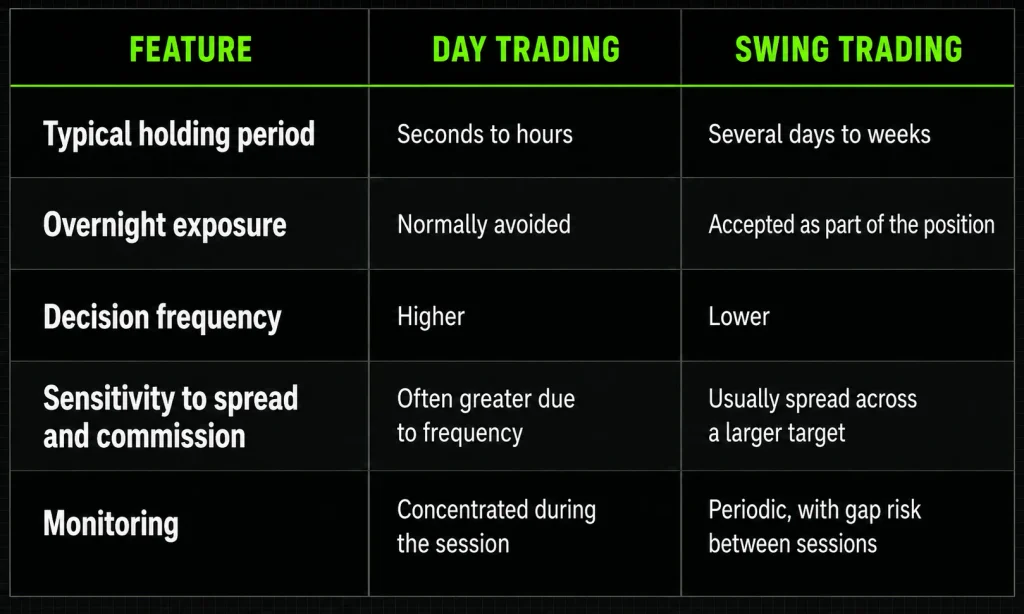
Neither style is inherently easier. Day traders face repeated execution, while swing traders face overnight gaps. Time availability often matters as much as market preference.
How to Start Day Trading Without Strategy Hopping
Changing method after a small run of losses leaves no stable sample to evaluate. A useful test keeps one setup fixed across different conditions. A demo account can clarify the rules, although simulated fills and the psychology of loss may differ from live trading.
The article The Fastest Way to Lose a Trader Has Nothing to Do With Trading examines the operational side. A strategy cannot remain consistent when the surrounding process encourages haste, fatigue or loss chasing.
Day Trading Tips That Survive Different Markets
The strongest basic strategies are conditional. A breakout needs a meaningful boundary, trend trading needs direction and range trading needs stable edges. A small watchlist, predefined risk and net results make the process easier to review. A no-trade day remains valid when the setup never appears.
Day trading is risky, and leverage can produce losses quickly. The Securities Commission Malaysia maintains resources on licensed entities and unauthorised firms. Product availability and client protections depend on the provider and jurisdiction. Claims of guaranteed returns deserve particular scepticism.
The Strategy Is Only the Starting Point
The best day trading strategies do not remove uncertainty. They turn it into a defined decision: a setup appears, a level confirms it, a stop identifies failure, and position size limits the damage.
For a beginner, progress appears in cleaner records, fewer unplanned trades, and more consistent execution. Leaving unsuitable moves untouched is part of the trading day.
- What Does It Mean to Day-Trade?
- What a Beginner Day Trader Actually Needs
- Five Popular Day Trading Strategies
- How Stock Day Trading Differs From Forex
- Risk Management Behind the Best Day Trading Strategies
- A Beginner Trading Plan for One Setup
- Day Trading Versus Swing Trading
- How to Start Day Trading Without Strategy Hopping
- Day Trading Tips That Survive Different Markets
- The Strategy Is Only the Starting Point